
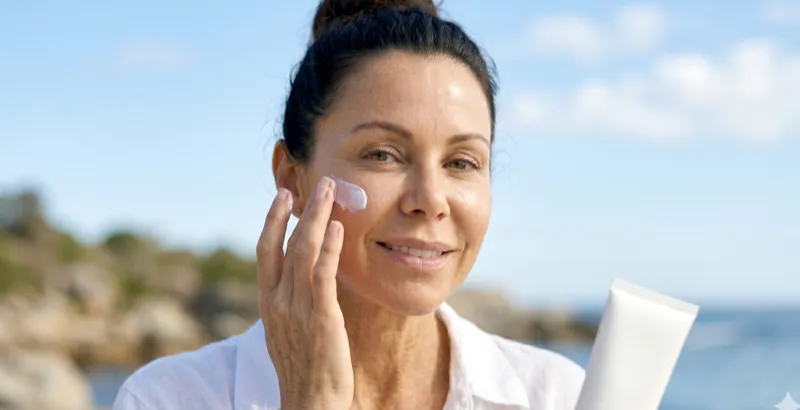
The science of skin aging is evolving rapidly — and for women navigating the skin changes that come with menopause and beyond, evidence-based skincare represents a fundamentally different approach: working with your skin's biology rather than against it.
Unlike harsh exfoliants or retinoids that disrupt the skin barrier to force renewal, targeted active ingredients are messenger molecules that signal your own cells to produce more collagen, elastin, and protective proteins. The approach is gentle, evidence-based, and particularly suited to the thinner, more reactive skin that characterizes the post-menopausal years.
Why UV-A Is the Real Collagen Threat and How to Block It
The distinction between UV-A (315-400nm) and UV-B (280-315nm) radiation is critically important for collagen preservation in mature skin, yet most women's understanding of sunscreen protection focuses disproportionately on SPF — a metric that measures only UV-B protection. UV-B is the wavelength that causes sunburn, and SPF quantifies the multiple of UV-B exposure required to produce erythema with sunscreen versus without. UV-A, however, is the wavelength primarily responsible for the dermal collagen degradation that drives photoaging. UV-A penetrates 10 times deeper into the skin than UV-B, reaching the reticular dermis where the bulk of structural collagen resides. A 2012 study in the Journal of Investigative Dermatology used in vivo confocal microscopy to visualize UV-A and UV-B effects on dermal collagen in real time and demonstrated that UV-A produced measurable collagen fiber fragmentation at depths of 0.2-1.0mm, while UV-B damage was confined to the epidermis and papillary dermis (0-0.2mm). For women over 40 whose existing collagen reserves are already diminished, UV-A protection is arguably more important than UV-B protection for anti-aging purposes.[1]
UV-A's collagen-destroying mechanism operates through activation of matrix metalloproteinases in dermal fibroblasts — the same cells responsible for producing new collagen. When UV-A photons reach the dermis, they generate reactive oxygen species (singlet oxygen, superoxide, hydroxyl radicals) that activate the AP-1 transcription factor, which in turn upregulates the expression of MMP-1 (interstitial collagenase), MMP-3 (stromelysin), and MMP-9 (gelatinase). These three MMPs collectively degrade collagen types I, III, and IV, plus elastin and proteoglycans — effectively dismantling every component of the dermal extracellular matrix. Simultaneously, UV-A-activated AP-1 suppresses TGF-β signaling, which is the primary driver of new collagen synthesis — creating a dual assault that both degrades existing collagen and impairs the production of replacement collagen. A 2002 landmark paper in Archives of Dermatology quantified this effect: a single UV-A exposure equivalent to 15 minutes of midday sun increased MMP-1 expression by 3-fold and decreased procollagen I expression by 50% for up to 48 hours. The cumulative effect of daily suberythemal UV-A exposure over decades accounts for the majority of visible facial aging.
Clinical research confirms that uV-A protection in sunscreens is measured differently across regulatory regions, creating confusion that disproportionately affects mature skin consumers who need to prioritize UV-A defense. In the United States, 'broad spectrum' designation requires a critical wavelength of 370nm or greater — a minimum standard that ensures some UV-A protection but does not guarantee the high-level UV-A defense optimal for anti-aging. In Japan and Korea, the PA rating system (PA+ through PA++++) provides a more granular measure of UV-A protection, with PA++++ indicating the highest available UV-A protection factor. In Europe, the UV-A circle logo indicates that the UV-A protection factor is at least one-third of the stated SPF — meaning an SPF 50 product with the UV-A logo provides at least UV-A PF 16.7. For women over 40 prioritizing collagen preservation, the clinical recommendation is to select sunscreens with the highest available UV-A rating: PA++++ in Asian formulations, UV-A circle logo with SPF 50 in European formulations, or broad-spectrum zinc oxide-based formulations in US products (zinc oxide is inherently superior for UV-A coverage compared to titanium dioxide or most chemical filters).
The practical implication for mature skin is that sunscreen selection should prioritize UV-A protection even at the expense of some UV-B factors. A sunscreen providing SPF 30 with excellent UV-A protection (e.g., 20% zinc oxide or PA++++ rating) offers better collagen preservation than a sunscreen providing SPF 100 with minimal UV-A protection. The marginal UV-B benefit between SPF 30 (97% UV-B blocked) and SPF 100 (99% UV-B blocked) is only 2%, while the difference in UV-A protection between adequate and excellent formulations can be 200-400%. For women using retinoids — which increase photosensitivity to both UV-A and UV-B — comprehensive UV-A protection is particularly critical, as retinoid-treated skin shows enhanced MMP activation in response to UV-A exposure that would be subclinical in non-retinoid users. The combination of morning antioxidant serum (vitamin C + vitamin E + ferulic acid), high UV-A protection sunscreen, and evening retinoid represents the evidence-based trifecta for collagen preservation: preventing damage (antioxidant + sunscreen) while stimulating repair (retinoid).
Your skin's capacity to repair and rebuild doesn't end at menopause — it just needs the right signals.
— Dr. Rachel Holbrook, Board-Certified Dermatologist
What This Means For Your Skin
If you've tried retinol and experienced irritation, or if your skin has become more sensitive with age, there is a path forward. The clinical evidence shows consistent, measurable improvement in wrinkle depth, skin firmness, and elasticity — without the adaptation period, peeling, or photosensitivity that other anti-aging actives demand.
Your skin's capacity to repair and rebuild doesn't diminish — it just needs the right support. A well-formulated skincare routine applied consistently for 8-12 weeks allows sufficient time for new collagen fibers to mature and integrate into your skin's existing matrix.
The science is clear. The evidence is consistent. The results are measurable.
What happens next is up to you.