
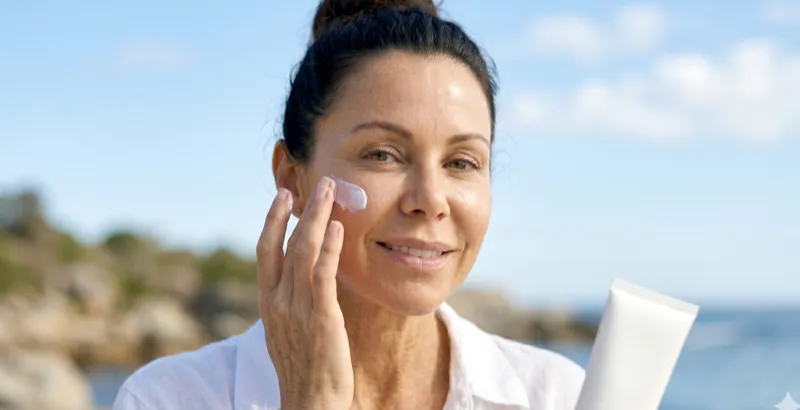
The science of skin aging is evolving rapidly — and for women navigating the skin changes that come with menopause and beyond, evidence-based skincare represents a fundamentally different approach: working with your skin's biology rather than against it.
Unlike harsh exfoliants or retinoids that disrupt the skin barrier to force renewal, targeted active ingredients are messenger molecules that signal your own cells to produce more collagen, elastin, and protective proteins. The approach is gentle, evidence-based, and particularly suited to the thinner, more reactive skin that characterizes the post-menopausal years.
How Daily SPF Prevents New Dark Spots and Fades Existing Ones
Daily sunscreen use is the single most effective intervention for preventing new dark spots and allowing existing hyperpigmentation to fade in women over 40 — more effective than any brightening serum, chemical peel, or laser treatment used without concurrent UV protection. The mechanism is direct: UV radiation is the primary trigger for the melanocyte hyperactivation that produces dark spots, and blocking UV radiation removes the stimulus. Solar lentigines (sun spots), melasma, and post-inflammatory hyperpigmentation all share UV-driven melanin overproduction as a common pathway, and all are prevented more effectively by UV avoidance than by treatment after the fact. A 2013 randomized controlled trial published in the Journal of Clinical Oncology demonstrated that daily sunscreen use reduced the development of new solar lentigines by 50% over 4.5 years, with the most pronounced protective effect in participants over 40 — the age when cumulative UV exposure begins manifesting as visible pigmentary changes.[1]
For existing dark spots, consistent sunscreen use creates the conditions necessary for natural fading by preventing the UV-driven melanin restimulation that maintains hyperpigmentation. When UV radiation strikes a dark spot, it reactivates the melanocytes in that area, which are already primed for overproduction — UV essentially 'refreshes' the dark spot by stimulating another round of melanin synthesis before the previous excess has been shed through natural cell turnover. By blocking this UV restimulation, daily sunscreen allows the natural 40-60 day cell turnover cycle in mature skin to gradually replace melanin-laden keratinocytes with normally pigmented cells. A 2014 study in the British Journal of Dermatology tracked dark spot fading in women using sunscreen-only versus sunscreen-plus-brightening-treatment and found that sunscreen alone produced a 13% reduction in melanin index over 12 weeks — confirming that UV protection provides inherent depigmenting benefit independent of active brightening ingredients.
Clinical research confirms that the type of UV protection matters specifically for pigmentation prevention. UV-A radiation drives melanin production more effectively than UV-B through activation of the opsin-3 photoreceptor in melanocytes, which triggers immediate pigment darkening (IPD) and persistent pigment darkening (PPD) responses. A 2018 study in the Journal of Investigative Dermatology identified that UV-A wavelengths between 320-400nm — and even visible light in the 400-500nm (blue light) range — stimulate melanogenesis in melanocytes, particularly in darker skin tones (Fitzpatrick III-VI). This means that sunscreens providing excellent UV-B protection (high SPF) but poor UV-A protection leave the melanin-stimulating wavelengths largely unblocked, providing minimal dark spot prevention despite high SPF values. For dark spot prevention specifically, zinc oxide at 15-20% provides the broadest coverage across UV-A I, UV-A II, and the UV-B range. Tinted sunscreens containing iron oxides add protection against visible light-induced pigmentation — a 2020 study demonstrated that tinted SPF reduced visible light-induced melanin stimulation by 72% compared to non-tinted SPF.
Integrating sunscreen into a comprehensive dark spot management protocol requires strategic coordination with active brightening ingredients. Morning sunscreen prevents new melanin stimulation while evening brightening treatments (retinoids for cell turnover acceleration, vitamin C or niacinamide for tyrosinase inhibition) work to reduce existing melanin deposits. This day-prevention/night-treatment approach produces synergistic results that exceed either strategy alone. A 2019 study in the Journal of Cosmetic Dermatology compared three protocols — sunscreen only, brightening treatment only, and sunscreen plus brightening treatment — in women with facial hyperpigmentation and found that the combination produced 62% greater melanin index reduction at 16 weeks compared to either alone. For women with hormonally-driven melasma (common during perimenopause), sunscreen is particularly critical because even minor UV exposure can reactivate melasma that has been successfully treated — dermatologists consider melasma 'controlled, not cured,' with relapse directly correlated to UV exposure lapses.
Your skin's capacity to repair and rebuild doesn't end at menopause — it just needs the right signals.
— Dr. Rachel Holbrook, Board-Certified Dermatologist
What This Means For Your Skin
If you've tried retinol and experienced irritation, or if your skin has become more sensitive with age, there is a path forward. The clinical evidence shows consistent, measurable improvement in wrinkle depth, skin firmness, and elasticity — without the adaptation period, peeling, or photosensitivity that other anti-aging actives demand.
Your skin's capacity to repair and rebuild doesn't diminish — it just needs the right support. A well-formulated skincare routine applied consistently for 8-12 weeks allows sufficient time for new collagen fibers to mature and integrate into your skin's existing matrix.
The science is clear. The evidence is consistent. The results are measurable.
What happens next is up to you.