
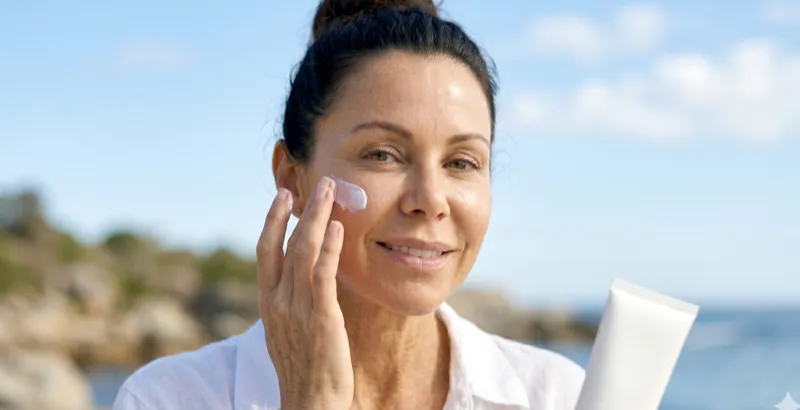
The science of skin aging is evolving rapidly — and for women navigating the skin changes that come with menopause and beyond, evidence-based skincare represents a fundamentally different approach: working with your skin's biology rather than against it.
Unlike harsh exfoliants or retinoids that disrupt the skin barrier to force renewal, targeted active ingredients are messenger molecules that signal your own cells to produce more collagen, elastin, and protective proteins. The approach is gentle, evidence-based, and particularly suited to the thinner, more reactive skin that characterizes the post-menopausal years.
Why Tinted SPF Is the Smartest Choice for Women Over 40
Tinted sunscreens have evolved from a cosmetic convenience into a clinically validated superior photoprotection strategy for aging skin, thanks to the discovery that iron oxide pigments — the same minerals that give tinted sunscreens their color — block visible light (400-700nm) wavelengths that standard UV filters miss entirely. This matters for aging skin because visible light, particularly high-energy visible (HEV) or blue light (400-500nm), has been shown to induce pigmentation, generate reactive oxygen species, and stimulate MMP expression in the dermis — effects previously attributed solely to UV radiation. A 2020 study in the Journal of the American Academy of Dermatology demonstrated that tinted sunscreen containing iron oxides reduced visible light-induced pigmentation by 72% compared to non-tinted SPF of equivalent UV protection, establishing that tinted sunscreens provide a measurably broader spectrum of photoprotection than their non-tinted counterparts.[1]
For women over 40, tinted sunscreen provides a triple function that streamlines the morning routine: UV protection, visible light protection, and cosmetic color correction. The iron oxide pigments in tinted sunscreens come in three primary shades — yellow (iron oxide CI 77492), red (iron oxide CI 77491), and black (iron oxide CI 77499) — which are blended to create skin-tone-matching tints that even out complexion, reduce the appearance of redness and dark spots, and provide a natural, luminous finish without the coverage weight of foundation. For mature skin with uneven pigmentation, rosacea, or post-inflammatory discoloration, this built-in color correction can replace or reduce the need for separate concealer and foundation, decreasing the total number of product layers on the skin and reducing the fine-line-accentuation that multi-layer makeup causes. A 2019 patient satisfaction survey found that 78% of women over 40 who switched from non-tinted sunscreen plus foundation to tinted sunscreen alone reported better skin appearance and comfort throughout the day.
Clinical research confirms that the formulation considerations for tinted sunscreen on aging skin differ from those for younger skin types. Mature skin benefits from tinted sunscreens with hydrating bases (hyaluronic acid, glycerin, squalane) rather than mattifying formulations that accentuate the dry, crepe-like texture common after menopause. Dewy or satin-finish tinted sunscreens create a more youthful appearance by reflecting light softly, while matte-finish formulations can make mature skin look flat and parched. The tint shade should be selected to match the undertone of the neck and décolleté rather than the face alone, as years of facial skincare often create a brightness mismatch between the treated face and the less-treated neck. For women with very fair or very deep skin tones — demographics often underserved by the 'light-medium-dark' shade range of most tinted sunscreens — mineral tinted sunscreens that can be mixed with untinted mineral SPF allow custom shade adjustment. A 2021 inclusive formulation study demonstrated that a 5-shade tinted mineral sunscreen range achieved acceptable color match for 89% of women across Fitzpatrick skin types I-VI.
The optimal tinted sunscreen for aging skin combines zinc oxide (15-20% for broad UV coverage), iron oxides (for visible light protection and color correction), and active skincare ingredients (niacinamide, vitamin E, hyaluronic acid for ongoing anti-aging benefit). Apply the standard 1/4 teaspoon amount for the face, using pressing and patting motions to distribute evenly without streaking the tint. For women who desire more coverage than tinted sunscreen alone provides, a thin layer of tinted SPF followed by targeted concealer on specific areas (under eyes, around nose, on dark spots) produces a polished finish with minimal product layering. Reapplication of tinted SPF throughout the day is simpler than reapplying non-tinted sunscreen under makeup: the tinted formula blends seamlessly with existing coverage, refreshing both UV protection and cosmetic finish simultaneously. The overarching principle for mature skin: tinted mineral sunscreen with iron oxides provides the broadest photoprotection (UV-B + UV-A + visible light) with the fewest ingredients, the best tolerance, and the most cosmetically beneficial finish of any sunscreen category.
Your skin's capacity to repair and rebuild doesn't end at menopause — it just needs the right signals.
— Dr. Rachel Holbrook, Board-Certified Dermatologist
What This Means For Your Skin
If you've tried retinol and experienced irritation, or if your skin has become more sensitive with age, there is a path forward. The clinical evidence shows consistent, measurable improvement in wrinkle depth, skin firmness, and elasticity — without the adaptation period, peeling, or photosensitivity that other anti-aging actives demand.
Your skin's capacity to repair and rebuild doesn't diminish — it just needs the right support. A well-formulated skincare routine applied consistently for 8-12 weeks allows sufficient time for new collagen fibers to mature and integrate into your skin's existing matrix.
The science is clear. The evidence is consistent. The results are measurable.
What happens next is up to you.