
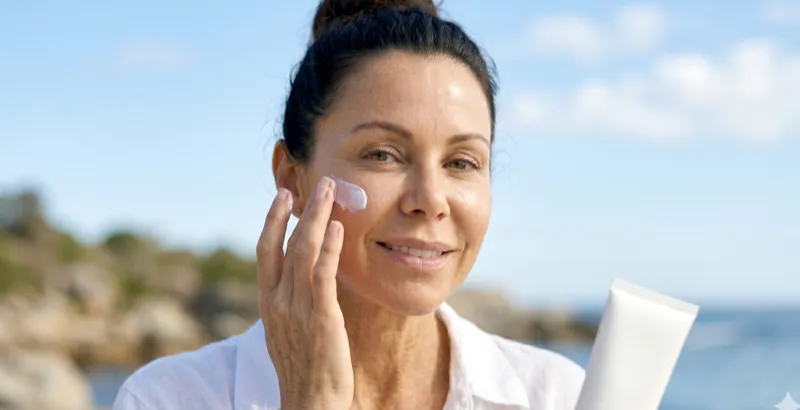
The science of skin aging is evolving rapidly — and for women navigating the skin changes that come with menopause and beyond, evidence-based skincare represents a fundamentally different approach: working with your skin's biology rather than against it.
Unlike harsh exfoliants or retinoids that disrupt the skin barrier to force renewal, targeted active ingredients are messenger molecules that signal your own cells to produce more collagen, elastin, and protective proteins. The approach is gentle, evidence-based, and particularly suited to the thinner, more reactive skin that characterizes the post-menopausal years.
How to Layer Sunscreen Under Makeup Without Pilling or Settling
Layering sunscreen under makeup on mature skin presents unique challenges that discourage many women from adequate daily UV protection. The primary issues — pilling (product rolling into visible balls during application), foundation separation (makeup sliding off the sunscreen layer), and fine line accentuation (sunscreen and makeup pooling in wrinkle troughs) — are more pronounced in mature skin due to the irregular surface texture, reduced sebum production, and the thicker product layers required by corrective makeup. A 2018 survey in the Journal of Cosmetic Dermatology found that 42% of women over 40 cited 'difficulty wearing under makeup' as their primary reason for inconsistent sunscreen use, despite understanding its importance — making this a compliance problem rather than an awareness problem. The solution lies in specific formulation selection, application technique, and layering timing that address the biophysical characteristics of mature skin.[1]
Formulation selection is the most critical factor for successful sunscreen-makeup layering on mature skin. Silicone-based sunscreens (containing dimethicone or cyclopentasiloxane as primary vehicle) create the smoothest base for makeup because the silicone fills micro-irregularities in the skin surface — including fine lines and enlarged pores — creating a primer-like effect that helps foundation glide on evenly. Water-based sunscreens, while lighter, tend to create a tacky film on mature skin that causes foundation to pill during application. A 2019 formulation study in the International Journal of Cosmetic Science tested 8 sunscreen vehicle types under foundation on women aged 45-60 and found that silicone-based vehicles produced 73% less pilling and 45% better foundation adhesion than water-based or alcohol-based vehicles. For women who prefer mineral sunscreens (zinc oxide), tinted formulations in a silicone base offer the best of both worlds: the gentle, non-sensitizing UV protection of minerals with the cosmetically elegant base of silicone — and the tint itself provides a color-correcting layer that reduces the amount of foundation needed.
Clinical research confirms that application technique for sunscreen under makeup on mature skin differs significantly from standard sunscreen advice. Rather than rubbing sunscreen into the skin (which displaces previously applied serums and creates friction-induced pilling on the textured mature surface), use a pressing and patting motion: dispense the full 1/4 teaspoon amount onto fingertips, warm between both hands, then press the palms against the face in overlapping sections, using patting to spread the product evenly. This technique deposits a uniform film without the shearing force that causes product displacement. Wait a minimum of 3 minutes — ideally 5 minutes — before applying primer or foundation. This wait time allows the sunscreen to set into a stable film; applying makeup too soon disrupts the even UV-protective layer and creates the milky, sliding effect that causes foundation separation. For the under-eye area, where skin is thinnest and most wrinkle-prone, apply a minimal amount of sunscreen with the ring finger using the lightest possible pressure, then wait the full 5 minutes before any concealer application.
Alternative SPF delivery methods can supplement or replace traditional sunscreen-under-makeup for women who find the layering process unacceptable. SPF-containing moisturizers (combining hydration and UV protection in one step) reduce the total number of layers between clean skin and makeup, minimizing pilling risk — though they must contain sufficient filter concentration to achieve their stated SPF, which some formulations do not. Cushion compacts with SPF 50 allow touchup reapplication of UV protection over makeup throughout the day without disturbing the makeup layer — pressing the cushion onto the face deposits a thin, even layer of tinted SPF that blends seamlessly with existing makeup. Powder SPF (mineral powders with zinc oxide or titanium dioxide) provides convenient reapplication for midday UV protection, though powder application alone does not deliver sufficient filter density for primary sun protection — it should be considered a supplement to, not replacement for, morning liquid or cream SPF. The universal principle for mature skin: fewer, thinner layers applied with gentle technique produce better UV protection and cosmetic outcomes than thick layers applied with aggressive rubbing.
Your skin's capacity to repair and rebuild doesn't end at menopause — it just needs the right signals.
— Dr. Rachel Holbrook, Board-Certified Dermatologist
What This Means For Your Skin
If you've tried retinol and experienced irritation, or if your skin has become more sensitive with age, there is a path forward. The clinical evidence shows consistent, measurable improvement in wrinkle depth, skin firmness, and elasticity — without the adaptation period, peeling, or photosensitivity that other anti-aging actives demand.
Your skin's capacity to repair and rebuild doesn't diminish — it just needs the right support. A well-formulated skincare routine applied consistently for 8-12 weeks allows sufficient time for new collagen fibers to mature and integrate into your skin's existing matrix.
The science is clear. The evidence is consistent. The results are measurable.
What happens next is up to you.