
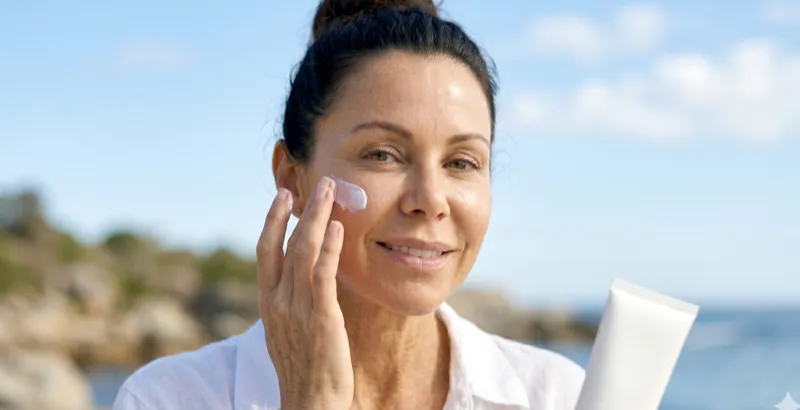
The science of skin aging is evolving rapidly — and for women navigating the skin changes that come with menopause and beyond, evidence-based skincare represents a fundamentally different approach: working with your skin's biology rather than against it.
Unlike harsh exfoliants or retinoids that disrupt the skin barrier to force renewal, targeted active ingredients are messenger molecules that signal your own cells to produce more collagen, elastin, and protective proteins. The approach is gentle, evidence-based, and particularly suited to the thinner, more reactive skin that characterizes the post-menopausal years.
When, How, and Why to Reapply SPF Throughout the Day After 40
Sunscreen reapplication is the most neglected aspect of photoprotection for women over 40, yet it may be the most critical — because the degradation of UV filters over time means that single-application morning sunscreen provides progressively diminishing protection throughout the day, leaving mature skin increasingly vulnerable during afternoon hours when cumulative UV exposure peaks. All sunscreen filters, both mineral and chemical, lose efficacy over time: chemical filters degrade through photolysis (the UV-absorbing chemical reaction itself consumes the filter molecules), while mineral filters lose effectiveness as the even particle distribution is disrupted by sebum, sweat, and mechanical contact. A 2017 study in the Journal of the American Academy of Dermatology measured SPF degradation throughout the day and found that a single morning application of SPF 50 sunscreen provided effective SPF 50 at time of application, approximately SPF 30 at 2 hours, SPF 15-20 at 4 hours, and SPF 8-12 at 6 hours — meaning that by early afternoon, morning-only sunscreen users have less than one-quarter of their initial protection.[1]
For mature skin, the consequences of afternoon UV exposure through degraded sunscreen are amplified by the reduced epidermal barrier and depleted antioxidant reserves that characterize aging skin. The UV-A radiation that penetrates degraded sunscreen in the afternoon hours is the same wavelength range responsible for MMP activation and collagen degradation — meaning that women who diligently apply retinol at night to stimulate collagen, then fail to maintain UV protection throughout the following day, are essentially rebuilding collagen at night and allowing it to be degraded during the afternoon. A 2015 modeling study in the British Journal of Dermatology estimated that consistent sunscreen reapplication every 2 hours during sun exposure prevents approximately 50% more cumulative collagen degradation per year compared to single morning application — a protection dividend that compounds dramatically over a decade. For women over 40 who are investing in anti-aging skincare, sunscreen reapplication is not optional but rather essential for protecting the return on that investment.
Clinical research confirms that practical reapplication methods for women wearing makeup include several evidence-based options that maintain UV protection without requiring complete makeup removal and reapplication. SPF-containing setting sprays, while not providing primary UV protection (spray application cannot deliver the film density needed for full SPF), do deposit a supplementary layer of UV filters that extends the morning sunscreen's effective duration. SPF cushion compacts (compact foundations with SPF 50) allow touch-up application of a meaningful UV-protective layer by pressing the product onto the skin over existing makeup — the cushion mechanism deposits a thin, uniform film rather than the streaky application of brush or sponge. Powdered mineral sunscreen (loose or pressed powder containing 20%+ zinc oxide) provides reapplication with zero disruption to makeup, though the coverage is thinner than liquid reapplication. A 2019 comparative study in Photodermatology evaluated these reapplication methods and found that cushion compact reapplication restored UV protection to 78% of the original morning SPF level, powder reapplication restored 45%, and spray reapplication restored 30% — confirming that cushion compacts are the most effective over-makeup reapplication method.
The reapplication schedule for women over 40 should be adapted to actual daily UV exposure patterns rather than following a rigid 2-hour rule. For office-based women whose sun exposure consists of morning commute, lunch break, and evening commute, a practical protocol is: full sunscreen application in the morning, cushion compact or powder reapplication at midday (before lunch break outdoor exposure), and an additional reapplication before the evening commute if applicable. For extended outdoor exposure (gardening, sports, beach), the standard 2-hour reapplication interval — or immediately after swimming or heavy sweating — remains the clinical recommendation. Window exposure in offices and cars should not be dismissed: standard glass blocks UV-B but transmits 60-70% of UV-A radiation, meaning women sitting near windows receive meaningful UV-A exposure throughout the workday. A 2010 study in the Journal of the American Academy of Dermatology documented that chronic left-sided facial UV-A exposure through car windows caused measurably greater photodamage on the left side of the face in habitual drivers — confirming that even indirect daily UV exposure contributes to cumulative skin aging.
Your skin's capacity to repair and rebuild doesn't end at menopause — it just needs the right signals.
— Dr. Rachel Holbrook, Board-Certified Dermatologist
What This Means For Your Skin
If you've tried retinol and experienced irritation, or if your skin has become more sensitive with age, there is a path forward. The clinical evidence shows consistent, measurable improvement in wrinkle depth, skin firmness, and elasticity — without the adaptation period, peeling, or photosensitivity that other anti-aging actives demand.
Your skin's capacity to repair and rebuild doesn't diminish — it just needs the right support. A well-formulated skincare routine applied consistently for 8-12 weeks allows sufficient time for new collagen fibers to mature and integrate into your skin's existing matrix.
The science is clear. The evidence is consistent. The results are measurable.
What happens next is up to you.