
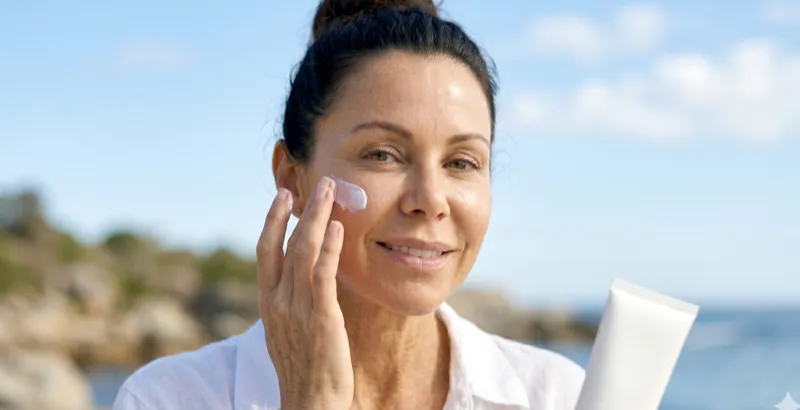
The science of skin aging is evolving rapidly — and for women navigating the skin changes that come with menopause and beyond, evidence-based skincare represents a fundamentally different approach: working with your skin's biology rather than against it.
Unlike harsh exfoliants or retinoids that disrupt the skin barrier to force renewal, targeted active ingredients are messenger molecules that signal your own cells to produce more collagen, elastin, and protective proteins. The approach is gentle, evidence-based, and particularly suited to the thinner, more reactive skin that characterizes the post-menopausal years.
Common Sunscreen Misconceptions That Put Aging Skin at Risk
Myth: 'I don't need sunscreen indoors or on cloudy days.' Reality: UV-A radiation — the wavelength most responsible for collagen degradation and pigmentation in mature skin — penetrates standard window glass at 60-75% transmission and penetrates cloud cover at 80% transmission. A 2010 study in the Journal of the American Academy of Dermatology documented that chronic unilateral UV-A exposure through car windows produced measurably greater photodamage, wrinkle depth, and pigmentation on the window-side face of habitual drivers — damage that accumulated through glass that transmitted zero UV-B (no sunburn risk) but abundant UV-A (significant aging risk). For women working near windows, the cumulative UV-A exposure over 8 hours of office work can equal 30-60 minutes of direct outdoor exposure, depending on window orientation and latitude. Cloud cover reduces UV-B more effectively than UV-A, meaning that overcast days may actually concentrate the photoaging wavelengths relative to the sunburn wavelengths — creating a deceptive scenario where the absence of sunburn risk masks ongoing collagen damage.[1]
Myth: 'Higher SPF means proportionally more protection.' Reality: The relationship between SPF value and UV-B blockage follows a logarithmic, not linear, curve — meaning the incremental benefit diminishes dramatically at higher SPF values. SPF 15 blocks 93% of UV-B, SPF 30 blocks 97%, SPF 50 blocks 98%, and SPF 100 blocks 99%. The difference between SPF 30 and SPF 100 is merely 2% additional UV-B blockage — clinically insignificant and far less important than the difference between proper and improper application technique. For mature skin, the more relevant consideration is UV-A protection, which SPF does not measure at all. A 2019 study in the Journal of the American Academy of Dermatology found that some SPF 100 products actually provided inferior UV-A protection compared to SPF 30 products with better UV-A filters — high SPF created a false sense of comprehensive protection while leaving the most aging UV wavelengths partially unblocked. The clinical recommendation for mature skin is SPF 30-50 with the highest available UV-A rating, rather than chasing ever-higher SPF numbers.
Clinical research confirms that myth: 'Dark skin doesn't need sunscreen for anti-aging.' Reality: While melanin does provide some inherent photoprotection (approximately SPF 3-4 in darker skin tones), this protection is focused on UV-B wavelengths and provides minimal defense against the UV-A radiation that drives dermal collagen degradation and the visible light (400-500nm) that drives hyperpigmentation in melanin-rich skin. A 2014 study in the Journal of Clinical and Aesthetic Dermatology demonstrated that women of color showed equivalent rates of UV-A-induced MMP-1 activation and collagen degradation as lighter-skinned women when melanin's photoprotective contribution was accounted for — meaning that dark skin ages through the same UV-A-driven collagen loss as light skin, just with less accompanying sunburn. Furthermore, hyperpigmentation — the most common dermatological concern in women of color — is directly UV-driven and requires consistent broad-spectrum and visible light protection for management. Tinted mineral sunscreens with iron oxides provide the visible light blockage that is specifically important for preventing pigmentation in darker skin tones.
Myth: 'Sunscreen chemicals are more dangerous than sun exposure.' Reality: This myth, amplified by social media, conflates legitimate regulatory questions about chemical filter safety with the thoroughly documented dangers of unprotected UV exposure. The FDA's 2019 request for additional safety data on chemical filters does not indicate that these filters are unsafe — it indicates that the existing safety data, generated decades ago, does not meet current regulatory standards for systemic absorption studies. No chemical sunscreen filter has been demonstrated to cause harm in humans at concentrations achieved through topical application. Conversely, unprotected UV exposure has been conclusively proven to cause: accelerated collagen degradation (the primary driver of visible aging), DNA mutations leading to skin cancer, immunosuppression, and progressive pigmentary damage. For women concerned about chemical filter absorption, mineral sunscreens (zinc oxide, titanium dioxide) provide equivalent or superior UV protection with zero systemic absorption — these are the two filters that the FDA has explicitly designated as 'Generally Recognized As Safe and Effective' (GRASE). The evidence-based position is clear: the risk of unprotected sun exposure far exceeds any theoretical risk from sunscreen ingredients.
Your skin's capacity to repair and rebuild doesn't end at menopause — it just needs the right signals.
— Dr. Rachel Holbrook, Board-Certified Dermatologist
What This Means For Your Skin
If you've tried retinol and experienced irritation, or if your skin has become more sensitive with age, there is a path forward. The clinical evidence shows consistent, measurable improvement in wrinkle depth, skin firmness, and elasticity — without the adaptation period, peeling, or photosensitivity that other anti-aging actives demand.
Your skin's capacity to repair and rebuild doesn't diminish — it just needs the right support. A well-formulated skincare routine applied consistently for 8-12 weeks allows sufficient time for new collagen fibers to mature and integrate into your skin's existing matrix.
The science is clear. The evidence is consistent. The results are measurable.
What happens next is up to you.