
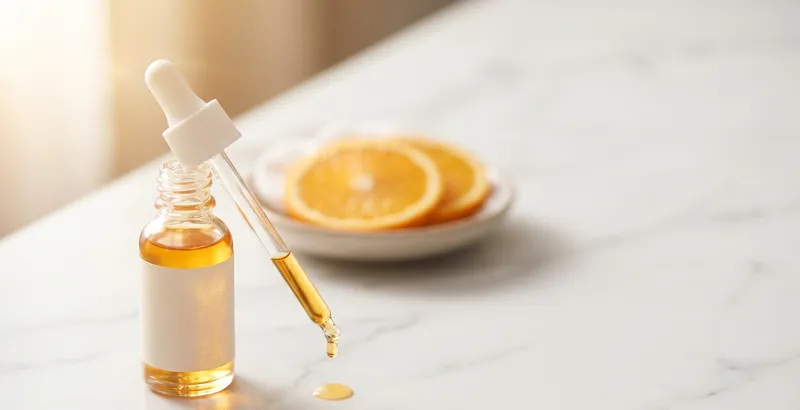
The science of skin aging is evolving rapidly — and for women navigating the skin changes that come with menopause and beyond, evidence-based skincare represents a fundamentally different approach: working with your skin's biology rather than against it.
Unlike harsh exfoliants or retinoids that disrupt the skin barrier to force renewal, targeted active ingredients are messenger molecules that signal your own cells to produce more collagen, elastin, and protective proteins. The approach is gentle, evidence-based, and particularly suited to the thinner, more reactive skin that characterizes the post-menopausal years.
Stability, Safety, and Efficacy Comparison of Homemade vs Commercial
The proliferation of DIY vitamin C serum recipes on social media and beauty blogs has created a significant public health and efficacy concern in dermatology, as the apparent simplicity of dissolving ascorbic acid powder in water belies the extraordinary formulation complexity required to create a product that is simultaneously stable, penetrating, safe, and efficacious. The typical DIY recipe involves dissolving L-ascorbic acid powder (USP grade) in distilled water at a 10-20% concentration, sometimes with the addition of vegetable glycerin as a humectant. While this produces a solution containing ascorbic acid at potentially therapeutic concentrations, it fundamentally fails to address the three critical challenges that professional formulators spend years and millions of dollars solving: oxidative stability, microbial contamination, and controlled penetration. A freshly prepared 20% ascorbic acid solution in water at room temperature begins measurable oxidation within hours — spectrophotometric studies show 5-10% degradation within 24 hours and 30-50% degradation within one week under typical bathroom storage conditions. Professional formulations employ multiple stabilization strategies simultaneously: optimized pH (precisely buffered to 2.8-3.2), chelating agents (EDTA, phytic acid) to sequester catalytic metal ions, antioxidant synergists (ferulic acid, tocopherol) that sacrifice themselves to protect ascorbic acid, specialized solvents (ethoxydiglycol, propanediol) that reduce water activity and thereby oxidation rate, and advanced packaging (nitrogen-purged, airless, amber) that minimizes oxygen and light exposure.[1]
Microbial contamination represents the most serious safety concern with DIY vitamin C preparations that is almost entirely absent from professional discourse, creating a dangerous knowledge gap. While L-ascorbic acid solutions below pH 3.5 have inherent antimicrobial properties against many bacteria, they do not constitute a preserved system against all potential contaminants. Molds (Aspergillus, Penicillium), yeasts (Candida), and acid-tolerant bacteria (Lactobacillus, Gluconobacter — the same organisms that convert wine to vinegar) can thrive at low pH and consume ascorbic acid as a carbon source. Professional formulations include broad-spectrum preservative systems (phenoxyethanol, ethylhexylglycerin, or caprylyl glycol combinations) specifically tested against challenge panels of USP-specified organisms. DIY preparations have no preservation, are prepared in non-sterile environments (kitchen surfaces harbor diverse microbial populations), stored in non-sterile containers (reused dropper bottles cannot be adequately sterilized without autoclaving), and handled with non-sterile fingers introducing skin flora with each use. The introduction of contaminated product to the periorbital area or over compromised skin (microabrasions from exfoliation, active acne lesions) creates genuine risk of folliculitis, contact dermatitis from microbial metabolites, or in rare cases, serious orbital cellulitis. Published case reports document bacterial skin infections attributed to contaminated homemade skincare, making this a tangible rather than theoretical concern.
Clinical research confirms that penetration efficacy — the ability to deliver ascorbic acid to viable cells at therapeutically meaningful concentrations — is where professional formulations demonstrate their most significant advantage over DIY preparations. Simple aqueous solutions of ascorbic acid rely entirely on passive diffusion across the stratum corneum, with penetration limited by the relatively low partition coefficient of ascorbic acid into the intercellular lipid matrix. Professional formulations employ multiple penetration enhancement strategies: co-solvents like ethoxydiglycol and propylene glycol that both dissolve ascorbic acid and disrupt stratum corneum lipid packing, surfactant-based penetration enhancers that temporarily increase membrane fluidity, film-forming polymers that maintain the formulation on the skin surface and prevent evaporation-driven crystallization of ascorbic acid (which renders it unavailable for absorption), and specific excipient systems that maintain the concentration gradient driving Fickian diffusion over extended periods. In comparative permeation studies using Franz diffusion cells with human cadaver skin, professional vitamin C serums deliver 3-7 fold more ascorbic acid to the viable epidermis and dermis at 24 hours compared to equivalent-concentration aqueous solutions — this difference represents the distinction between a cosmetically pleasant but dermatologically ineffective preparation and a therapeutically active treatment capable of stimulating measurable collagen synthesis.
The economic argument often advanced for DIY preparation — that pharmaceutical-grade ascorbic acid powder costs pennies per application while commercial serums cost dollars — collapses upon rigorous analysis of actual delivered value. A $30 professional serum containing 15% stabilized L-ascorbic acid with ferulic acid and vitamin E, used daily for 60 days (typical 30mL bottle lifespan), delivers approximately 60 doses of pharmaceutically-optimized, microbiologically-safe, reliably-penetrating vitamin C at approximately $0.50 per effective dose. A DIY preparation using $10 of ascorbic acid powder making weekly fresh batches (the minimum needed to avoid severe degradation) delivers 60 doses of progressively-degrading, contamination-prone, poorly-penetrating ascorbic acid water at approximately $0.17 per nominally-equivalent dose — but accounting for the 3-7 fold penetration deficit and ongoing degradation, the actual biologically-delivered cost per unit of dermal ascorbate is likely $0.50-1.20 per effective dose, making DIY more expensive on a efficacy-adjusted basis. For women over 40 investing time and money in their skin health, the professional formulation provides verified, reproducible clinical results backed by human studies, while DIY provides an unpredictable, potentially harmful experiment with no quality assurance. The one legitimate role for DIY preparation is as a short-term trial (using freshly-prepared, refrigerated, consumed within 48 hours) to assess skin tolerance to ascorbic acid before committing to a premium product purchase — but even this trial should be understood as delivering significantly less than what the purchased product will provide.
Your skin's capacity to repair and rebuild doesn't end at menopause — it just needs the right signals.
— Dr. Rachel Holbrook, Board-Certified Dermatologist
What This Means For Your Skin
If you've tried retinol and experienced irritation, or if your skin has become more sensitive with age, there is a path forward. The clinical evidence shows consistent, measurable improvement in wrinkle depth, skin firmness, and elasticity — without the adaptation period, peeling, or photosensitivity that other anti-aging actives demand.
Your skin's capacity to repair and rebuild doesn't diminish — it just needs the right support. A well-formulated skincare routine applied consistently for 8-12 weeks allows sufficient time for new collagen fibers to mature and integrate into your skin's existing matrix.
The science is clear. The evidence is consistent. The results are measurable.
What happens next is up to you.