
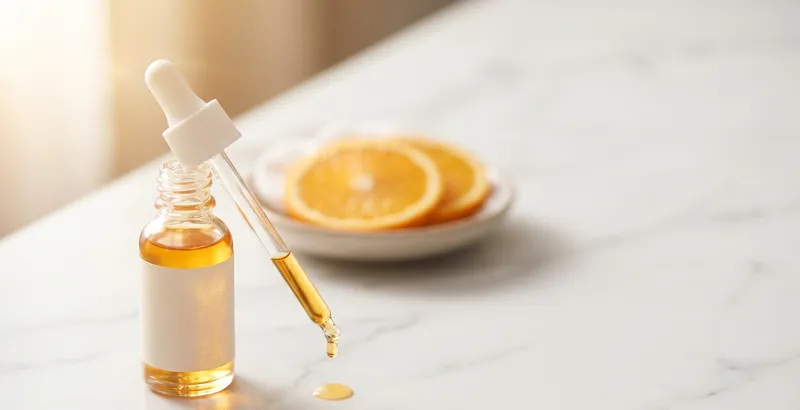
The science of skin aging is evolving rapidly — and for women navigating the skin changes that come with menopause and beyond, evidence-based skincare represents a fundamentally different approach: working with your skin's biology rather than against it.
Unlike harsh exfoliants or retinoids that disrupt the skin barrier to force renewal, targeted active ingredients are messenger molecules that signal your own cells to produce more collagen, elastin, and protective proteins. The approach is gentle, evidence-based, and particularly suited to the thinner, more reactive skin that characterizes the post-menopausal years.
Color Chemistry and Degradation Indicators in Ascorbate Solutions
Vitamin C serum oxidation represents one of the most significant yet underappreciated barriers to effective topical antioxidant therapy, particularly for mature women investing in premium skincare. The oxidative degradation of L-ascorbic acid follows a well-characterized chemical pathway: dissolved oxygen attacks the C2-C3 double bond of the enediol system, removing two hydrogen atoms to form dehydroascorbic acid (DHAA). This first oxidation step is reversible — DHAA retains some biological activity and can be reduced back to ascorbic acid by glutathione and thioredoxin systems within the skin. However, DHAA is highly unstable and rapidly undergoes irreversible hydrolytic ring opening to form 2,3-diketogulonic acid (2,3-DKG), which further degrades into threonic acid, oxalic acid, and various colored polymeric compounds through Maillard-type reactions with amino acids present in the formulation. These degradation products not only lack any beneficial skin activity but may actually generate free radicals through Fenton-type chemistry if trace metal ions (particularly iron and copper) are present, potentially causing more oxidative damage than they prevent. The visual color progression from clear/pale straw through yellow, amber, orange, to brown directly correlates with the ratio of intact LAA to degradation products and provides the most accessible indicator of product viability.[1]
The color transformation follows predictable chemistry that allows semi-quantitative assessment of remaining potency. Fresh L-ascorbic acid solutions are virtually colorless at concentrations below 10% and pale straw-yellow at 15-20% due to the faint absorption of ascorbate at 265nm in the UV range with minimal visible light absorption. The first visible color change to definite yellow indicates approximately 10-20% degradation — the product retains 80-90% of its original ascorbic acid content and remains clinically useful. Progression to dark yellow or light amber signifies 30-50% degradation, with efficacy meaningfully diminished but not zero. Orange coloration indicates 50-70% loss of active compound, at which point the product should be discontinued for anti-aging purposes though it retains some mild antioxidant capacity. Dark amber to brown represents greater than 70% degradation, and the accumulation of chromophoric degradation products (particularly erythorbic acid polymers and melanoidins from amino acid reactions) may now pose a net pro-oxidant risk. Importantly, this color scale applies specifically to L-ascorbic acid in aqueous solution — some derivatives (like ascorbyl tetraisopalmitate in oil) naturally appear yellow without indicating degradation, and certain formulations include other yellow-tinted ingredients (like ferulic acid or vitamin E) that complicate visual assessment.
Clinical research confirms that beyond color, several other organoleptic and physical changes indicate oxidative degradation that women should monitor. Fresh vitamin C serum has a mildly acidic, slightly metallic smell characteristic of ascorbic acid at low pH. As oxidation progresses, degradation products including threonic acid and various aldehydes generate an increasingly sour, vinegar-like or musty odor that becomes distinctly unpleasant in advanced stages. Textural changes also occur: some formulations develop increased viscosity or a slightly tacky feel as polymerized degradation products accumulate, while others may show phase separation with oily droplets or cloudy precipitates forming as the pH shifts upward and destabilizes the emulsion system. A tingling sensation upon application is normal for fresh LAA at low pH, but if this tingling becomes burning, stinging, or produces immediate erythema that was not present when the product was new, this suggests that pro-oxidant degradation products are causing irritant contact dermatitis. The skin itself provides feedback: if a previously well-tolerated vitamin C serum begins causing sensitivity, peeling, or paradoxical darkening (post-inflammatory hyperpigmentation), oxidative degradation should be suspected before concluding that the skin has developed an allergy to vitamin C.
Proactive strategies to prevent premature oxidation are particularly important for the economic and therapeutic investment that consistent vitamin C use represents. Storage temperature exerts the most significant influence on degradation rate — every 10°C increase approximately doubles the oxidation rate, making bathroom cabinet storage (often 25-30°C with humidity) far inferior to refrigeration (4°C) which can extend product viability by 3-5 fold. Light exposure, particularly UV and blue light wavelengths, photocatalytically accelerates oxidation through generation of singlet oxygen that attacks the ascorbate molecule. Amber or opaque packaging provides partial protection, but clear bottles — still used by many brands for aesthetic appeal — allow rapid photodegradation. Air exposure introduces the primary oxidant (molecular oxygen); once opened, even the best formulation begins a countdown. Airless pump containers minimize this by preventing backflow of air, whereas dropper bottles introduce fresh oxygen with each use. The practical recommendation is to purchase vitamin C serums in the smallest available size (15-30mL) that will be consumed within 8-12 weeks, store them in the refrigerator between uses, ensure the cap is securely closed immediately after each application, and discard any product showing color change beyond light yellow regardless of the printed expiration date. For mature skin on a budget, purchasing two small bottles sequentially rather than one large bottle ensures consistent delivery of active vitamin C throughout the treatment period.
Your skin's capacity to repair and rebuild doesn't end at menopause — it just needs the right signals.
— Dr. Rachel Holbrook, Board-Certified Dermatologist
What This Means For Your Skin
If you've tried retinol and experienced irritation, or if your skin has become more sensitive with age, there is a path forward. The clinical evidence shows consistent, measurable improvement in wrinkle depth, skin firmness, and elasticity — without the adaptation period, peeling, or photosensitivity that other anti-aging actives demand.
Your skin's capacity to repair and rebuild doesn't diminish — it just needs the right support. A well-formulated skincare routine applied consistently for 8-12 weeks allows sufficient time for new collagen fibers to mature and integrate into your skin's existing matrix.
The science is clear. The evidence is consistent. The results are measurable.
What happens next is up to you.