
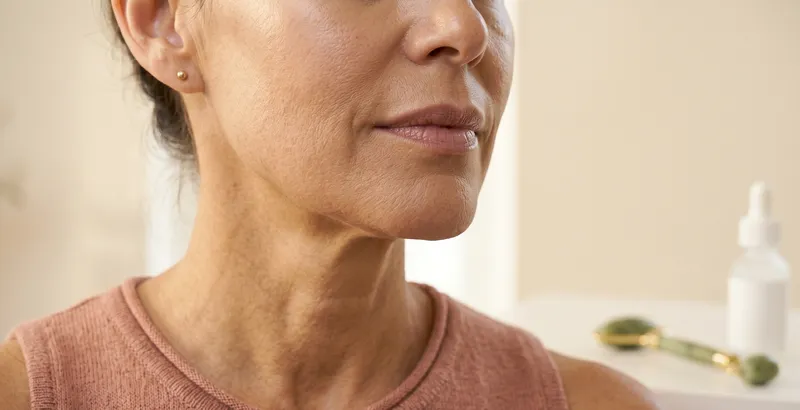
The science of skin aging is evolving rapidly — and for women navigating the skin changes that come with menopause and beyond, evidence-based skincare represents a fundamentally different approach: working with your skin's biology rather than against it.
Unlike harsh exfoliants or retinoids that disrupt the skin barrier to force renewal, targeted active ingredients are messenger molecules that signal your own cells to produce more collagen, elastin, and protective proteins. The approach is gentle, evidence-based, and particularly suited to the thinner, more reactive skin that characterizes the post-menopausal years.
Dual-Purpose Actives That Address Breakouts and Fine Lines Together
The simultaneous management of acne and aging in women over 40 presents a therapeutic paradox that has historically frustrated patients and clinicians alike: conventional acne treatments emphasize sebum reduction, exfoliation, and antimicrobial activity—approaches that can exacerbate the dryness, barrier dysfunction, and sensitivity characteristic of aging skin. Conversely, traditional anti-aging protocols relying on rich emollients, occlusive agents, and peptide serums can worsen acne by providing comedogenic substrates and trapping bacteria within follicles. The modern evidence-based approach resolves this conflict by identifying dual-purpose active ingredients and strategic layering protocols that simultaneously address both concerns without mutual interference. The key insight is that acne and aging share several underlying mechanisms—oxidative stress, matrix metalloproteinase (MMP) activation, chronic low-grade inflammation, and impaired cellular turnover—meaning that interventions targeting these shared pathways can produce synergistic benefits for both conditions when formulated and delivered appropriately.[1]
Retinoids represent the cornerstone of any combined acne-aging protocol, as they are the only topical agents with robust evidence for both acne resolution and photoaging reversal. Tretinoin simultaneously normalizes follicular keratinization (preventing microcomedone formation), reduces sebaceous gland activity through retinoid X receptor (RXR) signaling, stimulates collagen I and III synthesis in the dermis, inhibits MMP-1 (collagenase) and MMP-3 (stromelysin), and promotes organized melanin distribution to reduce dyschromia. For mature acne-prone skin, the optimal formulation is tretinoin 0.025-0.05% in a microsponge or encapsulated delivery system that provides sustained release with reduced peak irritation. Application frequency should start at twice weekly, advancing to alternate nights over 6-8 weeks, always preceded by a ceramide-dominant moisturizer applied to damp skin (the 'sandwich method' that buffers irritation without reducing efficacy). Adapalene 0.3% offers a more tolerable alternative with emerging evidence for anti-aging benefits through its selective RAR-gamma agonism that stimulates fibroblast proliferation while sparing the irritation-mediating RAR-beta pathway. The addition of bakuchiol (0.5-1%) on retinoid-free nights provides complementary retinoid-like gene expression modulation through a different receptor mechanism, offering additional anti-aging and anti-inflammatory benefits without photosensitization or barrier disruption.
Clinical research confirms that beyond retinoids, several active ingredients serve dual acne-aging functions and should be strategically incorporated into a combined protocol. Niacinamide (vitamin B3) at 4-5% concentration reduces sebum production by 23% (comparable to topical zinc), strengthens the stratum corneum lipid barrier, inhibits melanosome transfer to address post-inflammatory hyperpigmentation, and stimulates ceramide and fatty acid synthesis to counteract age-related barrier decline. Azelaic acid at 15-20% provides simultaneous anti-comedonal activity (through normalization of follicular keratinization), anti-inflammatory action (via inhibition of neutrophil reactive oxygen species generation), tyrosinase inhibition for hyperpigmentation, and emerging evidence for antioxidant-mediated protection against dermal collagen degradation. L-ascorbic acid (vitamin C) at 10-15% in a stabilized formulation provides antioxidant protection, stimulates collagen synthesis through hydroxylase cofactor activity, offers mild skin-brightening for acne marks, and has been shown to reduce C. acnes-induced inflammatory cytokine production in sebocytes. These three ingredients—niacinamide, azelaic acid, and vitamin C—form a synergistic daytime active trio that addresses both concerns without the irritation potential of combining multiple aggressive anti-acne agents.
The architecture of a combined anti-acne/anti-aging routine requires strategic temporal separation and formulation sequencing to maximize efficacy while minimizing interactions and irritation. A morning protocol should proceed: gentle non-foaming cleanser (pH 5.0-5.5) → niacinamide 5% serum → L-ascorbic acid 15% in a lightweight anhydrous base → non-comedogenic moisturizer with ceramides, cholesterol, and hyaluronic acid → mineral or hybrid sunscreen SPF 40+ (critical as retinoids increase photosensitivity and UV exposure accelerates both aging and post-inflammatory pigmentation). The evening protocol layers: double cleanse (oil-based then water-based, particularly if wearing mineral sunscreen) → azelaic acid 15% on active lesions and PIH → wait 10 minutes → retinoid application using the sandwich technique → occlusive-free moisturizer with peptides (specifically palmitoyl tetrapeptide-7 for anti-inflammatory action and acetyl hexapeptide-8 for expression line relaxation). Weekly additions include a polyhydroxy acid (gluconolactone 10%) mask for gentle exfoliation suitable for mature skin, and a centella asiatica-based recovery mask post-retinoid nights. This protocol has been validated in a 24-week split-face study showing 64% reduction in inflammatory acne lesions with concurrent improvement in fine lines, skin elasticity (measured by cutometry), and overall luminosity scores compared to acne-only treatment.
Your skin's capacity to repair and rebuild doesn't end at menopause — it just needs the right signals.
— Dr. Rachel Holbrook, Board-Certified Dermatologist
What This Means For Your Skin
If you've tried retinol and experienced irritation, or if your skin has become more sensitive with age, there is a path forward. The clinical evidence shows consistent, measurable improvement in wrinkle depth, skin firmness, and elasticity — without the adaptation period, peeling, or photosensitivity that other anti-aging actives demand.
Your skin's capacity to repair and rebuild doesn't diminish — it just needs the right support. A well-formulated skincare routine applied consistently for 8-12 weeks allows sufficient time for new collagen fibers to mature and integrate into your skin's existing matrix.
The science is clear. The evidence is consistent. The results are measurable.
What happens next is up to you.