
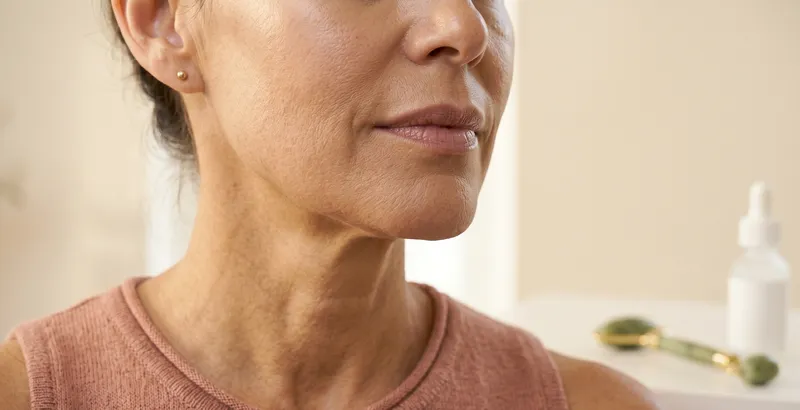
The science of skin aging is evolving rapidly — and for women navigating the skin changes that come with menopause and beyond, evidence-based skincare represents a fundamentally different approach: working with your skin's biology rather than against it.
Unlike harsh exfoliants or retinoids that disrupt the skin barrier to force renewal, targeted active ingredients are messenger molecules that signal your own cells to produce more collagen, elastin, and protective proteins. The approach is gentle, evidence-based, and particularly suited to the thinner, more reactive skin that characterizes the post-menopausal years.
How Retinoids Simultaneously Target Breakouts and Photoaging
Retinoids occupy a singular position in dermatology as the only topical compound class with Level 1 evidence for both acne vulgaris and photoaging, making them the indispensable foundation for women over 40 managing concurrent breakouts and wrinkles. The mechanism by which retinoids achieve this dual action stems from their profound influence on cellular differentiation, proliferation, and gene expression across multiple skin cell types. In the pilosebaceous unit, retinoids bind to nuclear retinoic acid receptors (RAR-alpha, beta, gamma) and retinoid X receptors (RXR-alpha, beta, gamma), forming heterodimers that modulate transcription of over 500 genes. For acne specifically, retinoids normalize the disordered desquamation of follicular corneocytes that initiates microcomedone formation, reduce cohesion between keratinocytes within the infundibulum (facilitating natural exfoliation), and downregulate toll-like receptor 2 expression on monocytes and keratinocytes—thereby reducing the inflammatory amplification that transforms comedones into papules and nodules. Simultaneously, these same RAR/RXR-mediated pathways stimulate fibroblast production of procollagen types I and III, inhibit UV-induced matrix metalloproteinases (particularly MMP-1, -3, and -9), promote glycosaminoglycan synthesis for improved dermal hydration, and normalize melanocyte activity to address dyschromia.[1]
The selection of appropriate retinoid type and concentration for mature acne-prone skin requires understanding the retinoid metabolism cascade and the distinct receptor binding profiles of available compounds. Over-the-counter retinol must undergo a two-step enzymatic conversion (retinol → retinaldehyde → retinoic acid) before achieving receptor activity, resulting in approximately 20-fold lower potency compared to prescription tretinoin. For women over 40 with both acne and photoaging, prescription retinoids are generally superior due to their direct receptor engagement without reliance on enzymatic conversion—which itself declines with age as retinol dehydrogenase expression decreases. Tretinoin (all-trans retinoic acid) at 0.025% provides the optimal starting concentration for mature skin: sufficient for comedolytic and collagen-stimulating activity while below the threshold for severe retinoid dermatitis in compromised barriers. Adapalene 0.3%, a synthetic retinoid with selective RAR-gamma binding, offers an alternative with superior anti-inflammatory properties, greater photostability, and reduced irritation potential—though with somewhat less robust anti-aging data. Trifarotene (RAR-gamma selective agonist) represents the newest option with theoretical advantages for mature skin due to its selective activation of the receptor subtype most expressed in adult skin versus the RAR-beta predominance of adolescent skin. Tazarotene 0.045% in a lotion vehicle (Arazlo) provides the highest potency option for severe acne with photoaging but demands careful protocol design in the over-40 population.
Clinical research confirms that the initiation and titration protocol for retinoid use in mature acne-prone skin must account for age-specific factors that increase sensitivity while maintaining therapeutic momentum. After age 40, epidermal thickness decreases by approximately 6.4% per decade, ceramide production falls, and the stratum corneum lipid bilayer becomes disorganized—collectively reducing barrier resilience to the initial adaptation phase. The evidence-supported protocol begins with application two nights per week for the first two weeks, applying retinoid over (not under) a ceramide-containing moisturizer (the 'buffering' technique reduces retinoid bioavailability by approximately 30% but crucially reduces irritation by 50-70% without eliminating efficacy). Frequency advances by one additional night every two weeks until reaching the target of five to seven nights weekly. The critical error to avoid is the 'more is better' approach: multiple studies confirm that 0.025% tretinoin applied consistently for 12 months produces equivalent collagen stimulation to 0.1% applied inconsistently due to irritation-induced breaks. For acne specifically, the therapeutic effect on follicular keratinization begins at 4-6 weeks and reaches maximum by 12 weeks—patients must understand this timeline to avoid premature discontinuation. The phenomenon of retinization—the adaptive process by which keratinocytes upregulate retinoid-binding proteins and develop tolerance—typically completes within 8-12 weeks, after which the protective buffering step can be eliminated and concentration upgraded if needed.
Practical considerations for long-term combined retinoid therapy in the acne-aging population include managing the so-called retinoid flare, addressing seasonal variation in tolerance, and integrating retinoid use with other anti-aging interventions. The initial retinoid flare—a transient worsening of acne during weeks 2-6 as previously forming microcomedones are accelerated to the surface—is often more pronounced in women over 40 because their baseline skin inflammation (inflammaging) amplifies the inflammatory component of purging lesions. Pre-treatment with azelaic acid 15% for 2-4 weeks before retinoid initiation can mitigate this flare by reducing baseline inflammation and normalizing keratinocyte proliferation. Seasonal adjustments are essential: during winter months when humidity drops and barrier function deteriorates, stepping down retinoid frequency by one night and adding a hyaluronic acid-based humectant layer prevents the irritation-induced acne paradox where excessive dryness triggers compensatory sebum production and new breakouts. Integration with injectable anti-aging treatments requires timing coordination: retinoids should be paused 3-5 days before and after neurotoxin or filler injections to ensure optimal diffusion and minimize bruising risk from retinoid-thinned skin. LED phototherapy at 633nm (red light) twice weekly synergizes with retinoid therapy by stimulating fibroblast activity through cytochrome c oxidase activation while simultaneously reducing C. acnes populations through photodynamic action—providing accelerated dual benefits.
Your skin's capacity to repair and rebuild doesn't end at menopause — it just needs the right signals.
— Dr. Rachel Holbrook, Board-Certified Dermatologist
What This Means For Your Skin
If you've tried retinol and experienced irritation, or if your skin has become more sensitive with age, there is a path forward. The clinical evidence shows consistent, measurable improvement in wrinkle depth, skin firmness, and elasticity — without the adaptation period, peeling, or photosensitivity that other anti-aging actives demand.
Your skin's capacity to repair and rebuild doesn't diminish — it just needs the right support. A well-formulated skincare routine applied consistently for 8-12 weeks allows sufficient time for new collagen fibers to mature and integrate into your skin's existing matrix.
The science is clear. The evidence is consistent. The results are measurable.
What happens next is up to you.