
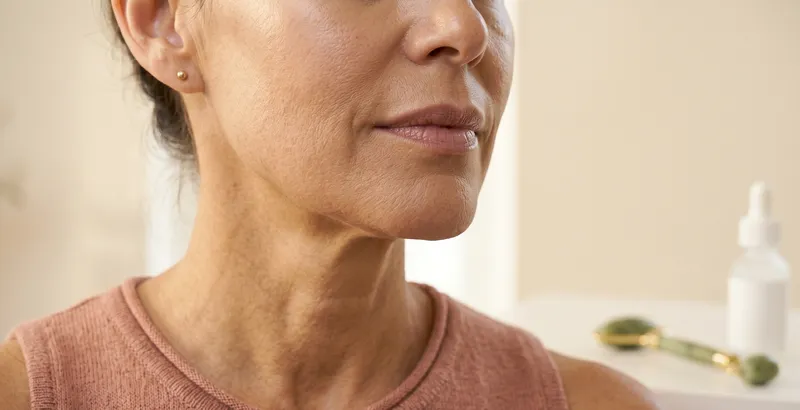
The science of skin aging is evolving rapidly — and for women navigating the skin changes that come with menopause and beyond, evidence-based skincare represents a fundamentally different approach: working with your skin's biology rather than against it.
Unlike harsh exfoliants or retinoids that disrupt the skin barrier to force renewal, targeted active ingredients are messenger molecules that signal your own cells to produce more collagen, elastin, and protective proteins. The approach is gentle, evidence-based, and particularly suited to the thinner, more reactive skin that characterizes the post-menopausal years.
Addressing Scarring in Skin With Reduced Collagen and Slower Healing
Acne scar treatment in women over 40 represents a clinical challenge distinct from scar treatment in younger patients, requiring fundamental modifications to standard protocols that account for age-related changes in dermal biology, healing capacity, and concurrent skin concerns. The skin of a 45-year-old woman differs from that of a 25-year-old in ways that directly impact scar treatment outcomes: dermal thickness has decreased by 15-20%, collagen density has declined by 1-2% per year since age 30 (cumulative loss of 15-30%), elastin fiber fragmentation has progressed, fibroblast density and proliferative capacity are reduced, blood vessel density and growth factor delivery are diminished, and the wound healing cascade—particularly the inflammatory and proliferative phases—operates at slower velocities with reduced amplitude. These changes mean that aggressive scar treatments designed to stimulate collagen remodeling in young, robust skin may produce inadequate responses (due to diminished fibroblast capacity) or excessive complications (due to reduced barrier resilience and slower repair) in mature skin. Simultaneously, many women over 40 present with the dual challenge of active hormonal acne producing new scars alongside existing scars from prior episodes—requiring a treatment plan that addresses active disease, prevents new scarring, and treats established scars without exacerbating either condition.[1]
Scar classification in mature skin requires additional assessment dimensions beyond the standard qualitative categories (ice pick, boxcar, rolling, hypertrophic, keloid). In women over 40, scars must be evaluated in the context of surrounding skin quality: a shallow boxcar scar that would be barely noticeable in taut, thick 25-year-old skin becomes visually prominent in thinner, less elastic mature skin—especially as gravity-related tissue descent accentuates shadowing within depressions. The phenomenon of 'scar unmasking' is common in this demographic: scars that were present but inconspicuous for years become newly visible as age-related volume loss and skin thinning progress. Additionally, post-inflammatory hyperpigmentation (PIH) and post-inflammatory erythema (PIE) behave differently in mature skin—PIH tends to persist longer due to slower epidermal turnover and melanin clearance, while PIE can be prolonged by age-related microvascular changes that slow hemoglobin clearance from the dermis. Assessment should include: scar morphology classification, depth assessment (shallow <0.5mm, medium 0.5-1.5mm, deep >1.5mm), surrounding skin elasticity (pinch test), dermal thickness assessment (ultrasound if available), Fitzpatrick skin type (determines PIH risk with procedures), and concurrent conditions (active acne, rosacea, melasma) that may contraindicate certain interventions.
Clinical research confirms that procedural interventions for acne scars in mature skin require energy level reduction, increased recovery intervals, and strategic sequencing that accounts for diminished healing capacity. Microneedling—the most versatile scar treatment for this demographic—should employ needle depths of 0.5-1.5mm (versus 1.5-2.5mm in younger skin), treatment intervals of 6-8 weeks (versus 4-6 weeks), and needle gauges of 33-34G (thinner needles producing less trauma per channel). Radiofrequency microneedling (Morpheus8, Vivace, Genius) adds thermal energy to stimulate heat-shock protein-mediated collagen remodeling, with settings reduced by 20-30% from standard protocols for mature skin: bipolar RF energy at 15-25mJ (versus 25-40mJ), depth settings of 1.0-2.0mm, and increased pulse duration for gentler thermal delivery. Fractional CO2 laser—the gold standard for deep scar remodeling—demands significant parameter modification in over-40 skin: power reduced to 10-15W (versus 20-30W), density reduced to 5-8% coverage (versus 10-20%), pulse duration extended for lower peak temperatures, and treatment limited to 1-2 passes (versus 2-4). These reduced parameters still generate meaningful scar improvement (40-55% over 3-5 sessions versus 50-70% in younger skin with aggressive parameters) while dramatically reducing the risks of prolonged erythema, hyperpigmentation, and delayed healing that plague aggressive protocols in mature skin.
The most effective approach for acne scars in mature skin combines structural scar treatments with concurrent anti-aging and skin quality interventions that synergistically improve overall appearance. This integrated strategy recognizes that improving surrounding skin quality—thickness, elasticity, hydration, evenness—reduces the visual contrast between scarred and unscarred tissue, often producing more dramatic perceived improvement than aggressive scar treatment alone. The recommended protocol layers treatments over 12-18 months: (1) Monthly sessions alternating between microneedling (with platelet-rich plasma for enhanced growth factor delivery to aging fibroblasts) and low-energy fractional laser (1540nm erbium glass or 1927nm thulium fiber for epidermal resurfacing without aggressive dermal ablation); (2) Injectable hyaluronic acid filler for volume restoration beneath rolling scars and areas of age-related volume loss that accentuates scar appearance—the 'lifting' effect of subdermal volume reduces scar visibility by 30-40% even before direct scar treatment; (3) TCA CROSS (chemical reconstruction of skin scars, trichloroacetic acid 70-90%) for ice pick scars—the only effective treatment for these narrow, deep defects—applied with extreme precision to avoid spreading to surrounding thin mature skin; (4) Continuous home regimen of tretinoin 0.025-0.05% (priming fibroblasts for enhanced treatment response), vitamin C 15% (collagen synthesis cofactor), and growth factor serum (EGF, TGF-β) to maximize collagen production between professional treatments. Post-procedure care for mature skin requires extended wound healing support: longer application of occlusive barrier repair products (7-10 days versus 3-5 days), delayed sun exposure resumption, and aggressive hydration protocols using hyaluronic acid layering during the vulnerable healing window.
Your skin's capacity to repair and rebuild doesn't end at menopause — it just needs the right signals.
— Dr. Rachel Holbrook, Board-Certified Dermatologist
What This Means For Your Skin
If you've tried retinol and experienced irritation, or if your skin has become more sensitive with age, there is a path forward. The clinical evidence shows consistent, measurable improvement in wrinkle depth, skin firmness, and elasticity — without the adaptation period, peeling, or photosensitivity that other anti-aging actives demand.
Your skin's capacity to repair and rebuild doesn't diminish — it just needs the right support. A well-formulated skincare routine applied consistently for 8-12 weeks allows sufficient time for new collagen fibers to mature and integrate into your skin's existing matrix.
The science is clear. The evidence is consistent. The results are measurable.
What happens next is up to you.