
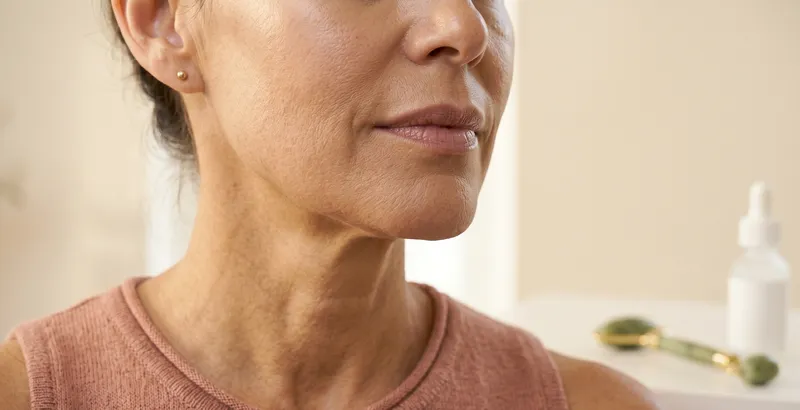
The science of skin aging is evolving rapidly — and for women navigating the skin changes that come with menopause and beyond, evidence-based skincare represents a fundamentally different approach: working with your skin's biology rather than against it.
Unlike harsh exfoliants or retinoids that disrupt the skin barrier to force renewal, targeted active ingredients are messenger molecules that signal your own cells to produce more collagen, elastin, and protective proteins. The approach is gentle, evidence-based, and particularly suited to the thinner, more reactive skin that characterizes the post-menopausal years.
Sebum Regulation and Barrier Repair Without Irritation or Dryness
Niacinamide (nicotinamide, vitamin B3) has emerged as one of the most valuable topical agents for managing hormonal acne in women over 40, occupying a unique therapeutic niche as a multifunctional active that simultaneously addresses acne pathogenesis, skin aging, and barrier dysfunction without the irritation, dryness, or photosensitivity associated with conventional acne treatments. This versatility is particularly relevant for mature women whose skin cannot tolerate aggressive anti-acne regimens designed for younger, more resilient complexions. The compound's mechanism of action spans multiple pathways relevant to hormonal acne: it reduces sebum excretion by 17-23% at concentrations of 2-4% through inhibition of lipogenic enzymes in sebocytes; it suppresses inflammatory cytokine production (IL-8, TNF-α) through inhibition of the NF-kB signaling pathway in keratinocytes exposed to C. acnes antigens; it prevents the transfer of melanosomes to keratinocytes, addressing post-inflammatory hyperpigmentation; and it enhances synthesis of ceramides, cholesterol, and free fatty acids in the stratum corneum, directly repairing the barrier dysfunction that both drives and results from acne in mature skin.[1]
The sebum-regulating properties of niacinamide operate through a mechanism distinct from conventional sebosuppressive agents (retinoids, anti-androgens), making it an ideal complementary therapy rather than a competitor to these treatments. While anti-androgens reduce sebum production by blocking hormonal signaling to sebocytes, niacinamide acts downstream at the metabolic level—it inhibits acetyl-CoA carboxylase and fatty acid synthase within sebocytes, reducing the conversion of glucose and acetate into the triglycerides and wax esters that constitute sebum. This metabolic suppression is inherently milder than hormonal suppression, producing a 20-25% reduction in sebum output rather than the 50-80% suppression achieved by isotretinoin or anti-androgens. However, this moderate reduction often represents the difference between a compensated system (adequate but not excessive sebum flow that maintains follicular clearance) and a decompensated one (sebum accumulation exceeding follicular drainage capacity). In perimenopausal women, this moderate sebum reduction is optimal because excessive suppression can worsen age-related xerosis and trigger compensatory hyperproliferation of follicular keratinocytes. The landmark Draelos 2006 study demonstrated that 2% niacinamide gel applied twice daily reduced sebum excretion rate by 23% while simultaneously improving skin texture scores by 28%—a dual outcome no conventional acne treatment achieves.
Clinical research confirms that the anti-inflammatory properties of niacinamide are mediated through its role as a precursor to nicotinamide adenine dinucleotide (NAD+) and its phosphorylated form NADP+—coenzymes essential for hundreds of cellular redox reactions. In the context of acne inflammation, NAD+-dependent enzymes including sirtuins (SIRT1, SIRT3) and poly(ADP-ribose) polymerase (PARP) regulate the inflammatory response at multiple levels: SIRT1 deacetylates NF-kB subunit p65, reducing its transcriptional activity and suppressing downstream inflammatory gene expression; SIRT3 reduces mitochondrial reactive oxygen species generation in keratinocytes exposed to bacterial antigens; and adequate NAD+ pools prevent PARP hyperactivation that otherwise depletes cellular energy and triggers necrotic inflammation. For perimenopausal women, NAD+ levels decline naturally with age (approximately 50% reduction between ages 40 and 60), meaning that topical niacinamide supplementation addresses a genuine age-related deficit in anti-inflammatory capacity. Clinical trials specific to adult female acne show that 4% niacinamide applied twice daily reduces inflammatory lesion count by 40-50% over 8 weeks—comparable to topical clindamycin without antibiotic resistance concerns—while simultaneously improving skin hydration (measured by corneometry) by 24% and reducing transepidermal water loss by 19%.
Optimal formulation and integration of niacinamide into a comprehensive hormonal acne protocol for women over 40 requires attention to concentration, pH, and strategic combination with synergistic actives. The concentration sweet spot for combined acne-aging benefits is 4-5%: below 2%, sebum-modulating effects are clinically insignificant; above 10%, some patients experience flushing and transient erythema (due to histamine release from dermal mast cells—not a true allergy but an uncomfortable prostaglandin-mediated vasodilation). The optimal pH range is 5.0-7.0, meaning niacinamide can be used at the same time as other actives without pH conflicts—unlike vitamin C (pH 2.5-3.5) or AHAs (pH 3.0-4.0) that require temporal separation. Synergistic combinations include niacinamide + zinc PCA (1-2%, combined sebum regulation through different mechanisms), niacinamide + N-acetylglucosamine (enhances barrier repair and pigment-correcting effects through hyaluronic acid precursor activity), and niacinamide + panthenol (B5, complementary barrier restoration). Niacinamide is compatible with—and enhances the tolerability of—retinoids, azelaic acid, and benzoyl peroxide, making it the ideal 'anchor' ingredient around which the rest of a mature acne routine is constructed. For maximum benefit in the hormonal acne population, a twice-daily application of 5% niacinamide serum should be maintained consistently regardless of what other actives cycle in and out of the routine, providing continuous sebum modulation, barrier support, and anti-inflammatory protection.
Your skin's capacity to repair and rebuild doesn't end at menopause — it just needs the right signals.
— Dr. Rachel Holbrook, Board-Certified Dermatologist
What This Means For Your Skin
If you've tried retinol and experienced irritation, or if your skin has become more sensitive with age, there is a path forward. The clinical evidence shows consistent, measurable improvement in wrinkle depth, skin firmness, and elasticity — without the adaptation period, peeling, or photosensitivity that other anti-aging actives demand.
Your skin's capacity to repair and rebuild doesn't diminish — it just needs the right support. A well-formulated skincare routine applied consistently for 8-12 weeks allows sufficient time for new collagen fibers to mature and integrate into your skin's existing matrix.
The science is clear. The evidence is consistent. The results are measurable.
What happens next is up to you.