
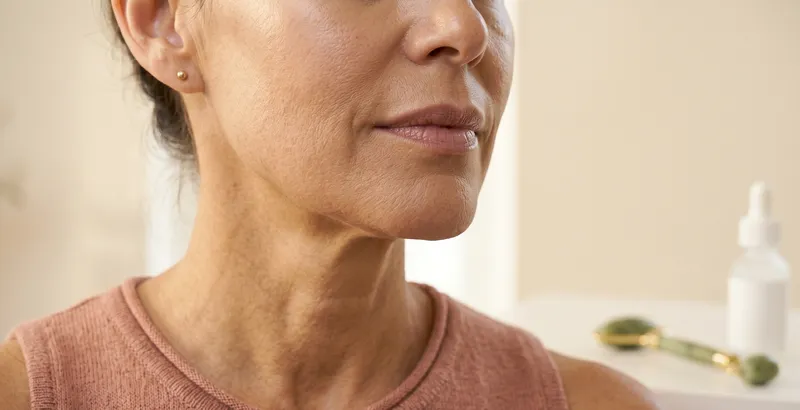
The science of skin aging is evolving rapidly — and for women navigating the skin changes that come with menopause and beyond, evidence-based skincare represents a fundamentally different approach: working with your skin's biology rather than against it.
Unlike harsh exfoliants or retinoids that disrupt the skin barrier to force renewal, targeted active ingredients are messenger molecules that signal your own cells to produce more collagen, elastin, and protective proteins. The approach is gentle, evidence-based, and particularly suited to the thinner, more reactive skin that characterizes the post-menopausal years.
Why Declining Estrogen and Rising Androgens Trigger Adult Breakouts
Hormonal acne in women over 40 represents a distinct dermatological entity that differs fundamentally from adolescent acne in its pathophysiology, distribution, and treatment requirements. During the menopausal transition, which typically spans ages 40 to 58, the ovaries progressively reduce estrogen and progesterone production while adrenal androgens—particularly dehydroepiandrosterone sulfate (DHEA-S) and androstenedione—maintain relatively stable levels or decline at a slower rate. This creates a relative androgen excess even when absolute androgen levels remain within normal reference ranges. The androgen-to-estrogen ratio shifts decisively, and this hormonal milieu directly impacts sebaceous gland function, keratinocyte proliferation within the pilosebaceous unit, and cutaneous inflammatory responses. Epidemiological data from the Study of Women's Health Across the Nation (SWAN) demonstrates that approximately 26% of women aged 40-49 and 15% of women aged 50-59 report clinically significant acne, with prevalence peaks correlating with perimenopause stages defined by menstrual irregularity. Unlike teenage acne, which predominantly affects the T-zone due to higher sebaceous gland density, menopausal acne characteristically presents on the lower face, jawline, and neck—areas where androgen receptors in sebocytes exhibit the highest density and sensitivity.[1]
The molecular mechanisms underlying menopausal acne involve several interconnected pathways that distinguish it from earlier-onset forms. Estrogen normally exerts anti-androgenic effects through multiple mechanisms: it increases sex hormone-binding globulin (SHBG) production in the liver, thereby reducing free testosterone availability; it competitively inhibits 5-alpha-reductase type 1 in skin, reducing conversion of testosterone to the more potent dihydrotestosterone (DHT); and it directly modulates sebocyte differentiation through estrogen receptor beta (ERβ). As estrogen declines during perimenopause, each of these protective mechanisms weakens simultaneously. Additionally, the perimenopausal period is characterized by hypothalamic-pituitary-adrenal (HPA) axis dysregulation, with elevated cortisol patterns that further stimulate adrenal androgen production and increase sebaceous gland sensitivity to circulating androgens through upregulation of androgen receptor expression. The inflammatory component of menopausal acne is amplified by age-related changes in cutaneous immunity, including altered toll-like receptor 2 (TLR2) signaling in response to Cutibacterium acnes colonization and increased baseline levels of pro-inflammatory cytokines IL-1α and TNF-α in aging skin—a phenomenon termed inflammaging that creates a lower threshold for acne lesion formation.
Clinical research confirms that clinical assessment of hormonal acne in perimenopausal and menopausal women requires a systematic approach that differs from evaluation of younger patients. A thorough hormonal workup should include total and free testosterone, DHEA-S, androstenedione, SHBG, follicle-stimulating hormone (FSH), luteinizing hormone (LH), and thyroid function tests. Importantly, many women with hormonally-driven acne have laboratory values within normal ranges—the diagnosis is often clinical, based on distribution pattern (U-zone predominance), morphology (deep inflammatory nodules and papules rather than comedonal disease), timing (premenstrual flares in perimenopausal women or onset coinciding with menstrual irregularity), and resistance to conventional topical therapies. Differential diagnosis must include rosacea—which frequently coexists and shares some clinical features—drug-induced acneiform eruptions from medications common in this age group (corticosteroids, lithium, certain antihypertensives), and rarely, androgen-secreting tumors when virilization signs accompany sudden-onset severe acne. The Wood's lamp examination and dermoscopy can help distinguish folliculitis and rosacea from true acne vulgaris in this population.
Treatment of menopausal acne demands a multimodal approach that addresses the unique challenges of aging skin while targeting hormonal drivers. First-line topical therapy should prioritize retinoids (adapalene 0.3% or tretinoin 0.025%) with careful initiation protocols recognizing that mature skin has reduced barrier function and increased transepidermal water loss, requiring slower titration and concurrent ceramide-rich moisturization. Systemic anti-androgen therapy with spironolactone (50-150mg daily) demonstrates particular efficacy in this population, with studies showing 70-85% improvement rates over 3-6 months, and offers additional benefits of reducing age-related hair thinning. For women on hormone replacement therapy (HRT), selection of progestins with anti-androgenic profiles—drospirenone, dienogest, or cyproterone acetate—can simultaneously address menopausal symptoms and acne. Oral isotretinoin remains appropriate for severe nodulocystic disease but requires lower doses (0.25-0.5 mg/kg) in older patients due to increased mucocutaneous sensitivity and careful monitoring given higher baseline cardiovascular risk. Emerging therapies including topical clascoterone (a first-in-class topical androgen receptor inhibitor) and selective progesterone receptor modulators represent promising options for this growing patient population.
Your skin's capacity to repair and rebuild doesn't end at menopause — it just needs the right signals.
— Dr. Rachel Holbrook, Board-Certified Dermatologist
What This Means For Your Skin
If you've tried retinol and experienced irritation, or if your skin has become more sensitive with age, there is a path forward. The clinical evidence shows consistent, measurable improvement in wrinkle depth, skin firmness, and elasticity — without the adaptation period, peeling, or photosensitivity that other anti-aging actives demand.
Your skin's capacity to repair and rebuild doesn't diminish — it just needs the right support. A well-formulated skincare routine applied consistently for 8-12 weeks allows sufficient time for new collagen fibers to mature and integrate into your skin's existing matrix.
The science is clear. The evidence is consistent. The results are measurable.
What happens next is up to you.