
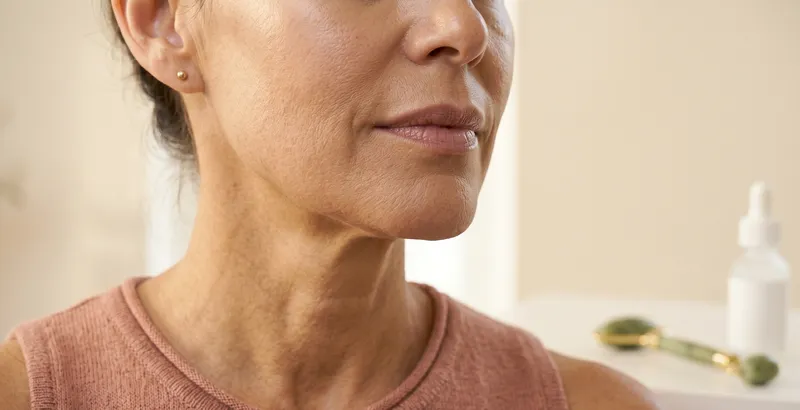
The science of skin aging is evolving rapidly — and for women navigating the skin changes that come with menopause and beyond, evidence-based skincare represents a fundamentally different approach: working with your skin's biology rather than against it.
Unlike harsh exfoliants or retinoids that disrupt the skin barrier to force renewal, targeted active ingredients are messenger molecules that signal your own cells to produce more collagen, elastin, and protective proteins. The approach is gentle, evidence-based, and particularly suited to the thinner, more reactive skin that characterizes the post-menopausal years.
How Relative Androgen Excess Drives Sebaceous Gland Hyperactivity
Androgen dominance in the menopausal transition represents a relative rather than absolute hormonal state—a crucial distinction that is frequently misunderstood by both patients and non-specialist practitioners. During the 5-10 year perimenopausal window, ovarian estradiol production declines by 60-80% while ovarian and adrenal androgen production decreases by only 25-50%. This differential rate of decline creates a new hormonal equilibrium where androgens—testosterone, androstenedione, DHEA, and DHEA-S—assume proportionally greater influence on androgen-responsive tissues including the pilosebaceous unit. Critically, sex hormone-binding globulin (SHBG) levels fall concurrently with estrogen decline (since estrogen is the primary stimulus for hepatic SHBG synthesis), further amplifying free androgen bioavailability. The clinical implications are significant: a woman whose total testosterone measures 25 ng/dL (well within the normal female range of 15-70 ng/dL) may experience pronounced androgenic skin effects if her SHBG has halved from perimenopausal changes, effectively doubling her free testosterone index. This explains why standard hormone panels often appear reassuringly normal in women with clinically obvious androgen-driven acne, leading to inappropriate dismissal of their symptoms.[1]
The intracrine androgen metabolism pathway within skin tissue represents an additional layer of complexity in menopausal androgen dominance acne. Sebaceous glands are not merely passive targets of circulating androgens—they function as independent steroidogenic organs capable of synthesizing potent androgens from weak precursors entirely through local enzymatic machinery. The key enzymes include 3-beta-hydroxysteroid dehydrogenase (3β-HSD, converting DHEA to androstenedione), 17-beta-hydroxysteroid dehydrogenase (17β-HSD type 3 and 5, converting androstenedione to testosterone), and 5-alpha-reductase (types 1 and 2, converting testosterone to DHT). Studies of menopausal women with acne reveal upregulation of these intracrine enzymes within sebaceous glands—particularly 5-alpha-reductase type 1, which increases expression by 30-45% in perimenopausal skin compared to premenopausal controls. This means that even when circulating androgen levels are unremarkable, the sebaceous gland microenvironment may contain DHT concentrations 5-10 times higher than what serum measurements would predict. Furthermore, aging-related changes in local aromatase activity (the enzyme converting androgens to estrogens within skin) decrease after menopause, removing another protective counter-regulatory mechanism and further tipping the intracrine balance toward androgenic dominance within the pilosebaceous unit.
Clinical research confirms that clinical identification of androgen dominance as the primary driver of menopausal acne involves pattern recognition across multiple organ systems, as the skin is rarely the only affected tissue. The androgen dominance phenotype in perimenopausal women typically presents as a constellation: acne concentrated on the lower face and neck; progressive thinning of scalp hair (female pattern hair loss, Ludwig type I-II); increased facial vellus hair thickness or new terminal hair growth on the upper lip, chin, or sideburn area; increased seborrhea of the scalp with associated seborrheic dermatitis; and often concurrent metabolic features including central adiposity, glucose intolerance, and dyslipidemia. The acne morphology is characteristically inflammatory rather than comedonal—deep papules and nodules that resist standard topical therapy and leave prolonged post-inflammatory erythema or hyperpigmentation. When evaluating these patients, the most diagnostically useful laboratory parameters are free testosterone (by equilibrium dialysis), free androgen index (total testosterone × 100 / SHBG), DHEA-S, and early morning 17-hydroxyprogesterone (to screen for nonclassical congenital adrenal hyperplasia). A free androgen index above 5 in a postmenopausal woman or above 8 in a perimenopausal woman strongly supports androgen dominance as the primary acne driver.
Therapeutic management of androgen dominance acne in menopause targets multiple levels of the androgen signaling cascade—from adrenal production through peripheral conversion to receptor binding. Spironolactone (100-200mg daily) remains the gold standard systemic anti-androgen for this population, acting through competitive antagonism of the androgen receptor, inhibition of 5-alpha-reductase, and reduction of adrenal androgen synthesis via inhibition of CYP17A1 (17-alpha-hydroxylase). Response rates in postmenopausal women exceed those in younger populations (80-90% significant improvement by 6 months), likely because the dominant pathophysiological mechanism is more purely hormonal without the confounding factors of adolescent skin. For women who cannot tolerate spironolactone (hyperkalemia risk in those on ACE inhibitors or ARBs, common in this age group), alternatives include finasteride 2.5mg daily (5-alpha-reductase inhibitor, off-label but effective for both acne and hair loss) and flutamide 62.5-125mg daily (pure androgen receptor antagonist requiring liver function monitoring). Topical clascoterone 1% cream applied twice daily provides local androgen receptor blockade without systemic effects—particularly valuable in women with comorbidities contraindicating systemic therapy. The addition of metformin 500-1000mg daily addresses the metabolic component of androgen dominance by improving insulin sensitivity (insulin stimulates ovarian theca cell androgen production and reduces hepatic SHBG synthesis), providing comprehensive hormonal rebalancing when combined with anti-androgen therapy.
Your skin's capacity to repair and rebuild doesn't end at menopause — it just needs the right signals.
— Dr. Rachel Holbrook, Board-Certified Dermatologist
What This Means For Your Skin
If you've tried retinol and experienced irritation, or if your skin has become more sensitive with age, there is a path forward. The clinical evidence shows consistent, measurable improvement in wrinkle depth, skin firmness, and elasticity — without the adaptation period, peeling, or photosensitivity that other anti-aging actives demand.
Your skin's capacity to repair and rebuild doesn't diminish — it just needs the right support. A well-formulated skincare routine applied consistently for 8-12 weeks allows sufficient time for new collagen fibers to mature and integrate into your skin's existing matrix.
The science is clear. The evidence is consistent. The results are measurable.
What happens next is up to you.