
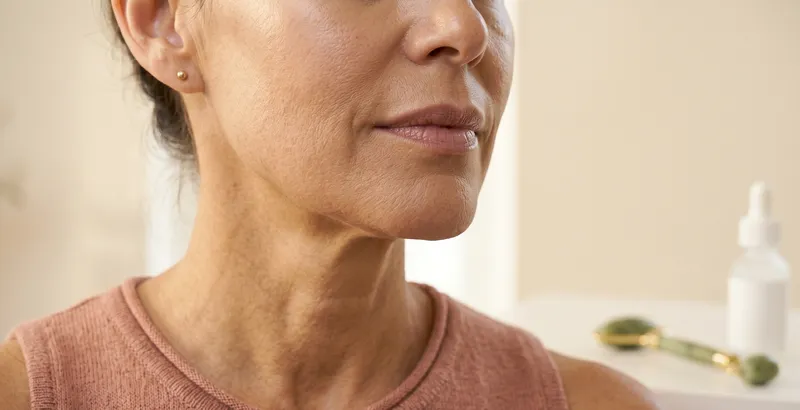
The science of skin aging is evolving rapidly — and for women navigating the skin changes that come with menopause and beyond, evidence-based skincare represents a fundamentally different approach: working with your skin's biology rather than against it.
Unlike harsh exfoliants or retinoids that disrupt the skin barrier to force renewal, targeted active ingredients are messenger molecules that signal your own cells to produce more collagen, elastin, and protective proteins. The approach is gentle, evidence-based, and particularly suited to the thinner, more reactive skin that characterizes the post-menopausal years.
Plant-Based Anti-Androgens That Mirror Pharmaceutical Mechanisms
Spironolactone has established itself as the gold-standard systemic treatment for hormonal acne in adult women, with efficacy rates of 70-85% and a well-characterized safety profile over decades of use. However, a significant subset of women—estimated at 20-30% of potential candidates—cannot tolerate or choose not to use this medication due to side effects (breast tenderness, menstrual irregularity, potassium elevation, orthostatic hypotension), drug interactions (particularly with ACE inhibitors and ARBs common in the over-40 demographic), contraindications (renal impairment, hyperkalemia), or personal preference for pharmaceutical-free approaches. Understanding spironolactone's mechanism of action is essential for identifying natural alternatives that target the same biochemical pathways: spironolactone works through four distinct anti-androgenic mechanisms—competitive antagonism of the androgen receptor (preventing DHT binding), inhibition of 5-alpha-reductase (reducing conversion of testosterone to DHT), inhibition of adrenal androgen synthesis via CYP17A1 blockade, and displacement of testosterone from albumin binding sites. An effective natural alternative need not replicate all four mechanisms simultaneously but should meaningfully impact at least two of these pathways to achieve clinically relevant anti-androgenic skin effects.[1]
Saw palmetto (Serenoa repens) represents the most pharmacologically validated botanical anti-androgen with direct mechanistic parallels to spironolactone. Its liposterolic extract (standardized to 85-95% fatty acids including lauric, myristic, oleic, and palmitic acids plus plant sterols including beta-sitosterol) inhibits both type 1 and type 2 5-alpha-reductase with an IC50 approximately 10-fold higher than finasteride—clinically relevant at standard doses of 320mg daily. Additionally, saw palmetto demonstrates competitive androgen receptor binding activity, blocking DHT from engaging its nuclear receptor in target tissues including sebocytes. A 2020 open-label study in 20 women with hormonal acne demonstrated 38% reduction in inflammatory lesion count after 12 weeks of saw palmetto supplementation (320mg standardized extract daily), with corresponding 19% reduction in sebum excretion rate measured by sebumeter. While less potent than spironolactone's 70-85% improvement, this magnitude of effect—combined with essentially zero adverse effects—positions saw palmetto as a viable first-line natural approach for mild-to-moderate hormonal acne or as an adjunctive therapy to enhance moderate-dose spironolactone. The combination of saw palmetto with reishi mushroom extract (Ganoderma lucidum, 3g daily)—which independently demonstrates 5-alpha-reductase inhibition through its triterpenoid compounds, particularly ganoderic acids—provides additive enzyme inhibition through complementary binding site interactions.
Clinical research confirms that beyond direct anti-androgen botanicals, several natural compounds address the upstream drivers of androgen excess that are particularly relevant to perimenopausal women. Berberine (500mg twice daily with meals), derived from Berberis vulgaris, demonstrates metformin-equivalent insulin-sensitizing activity through AMPK pathway activation—reducing the hyperinsulinemia that drives ovarian androgen production and suppresses SHBG. Clinical trials in women with PCOS (who share the insulin-androgen pathogenesis with perimenopausal acne) demonstrate that berberine reduces total testosterone by 25-30%, increases SHBG by 35-45%, and reduces free androgen index by 50-60% over 3-6 months. Inositol—specifically the combination of myo-inositol (4g daily) plus D-chiro-inositol (100mg daily) in the physiological 40:1 ratio—acts as an insulin-sensitizing second messenger that improves insulin receptor signaling efficiency, with RCT evidence showing 40-50% reduction in free testosterone and significant improvement in acne scores in hyperandrogenic women. White peony extract (Paeonia lactiflora, standardized to 10% paeoniflorin, 500mg twice daily) inhibits androgen synthesis through aromatase induction (promoting conversion of androgens to estrogens) and 17,20-lyase inhibition—a mechanism similar to one component of spironolactone's action. The combination of berberine, inositol, and white peony addresses the metabolic-hormonal-enzymatic triad simultaneously, providing multi-target anti-androgenic activity through distinct mechanisms.
Practical implementation of a natural anti-androgen protocol requires realistic timeline expectations, monitoring parameters, and clear criteria for escalation to pharmaceutical therapy. Unlike spironolactone, which reaches steady-state receptor occupancy within 1-2 weeks (though clinical improvement takes 3-4 months due to the acne lesion lifecycle), botanical anti-androgens typically require 4-8 weeks to achieve meaningful hormonal shifts and 12-16 weeks for visible skin improvement—patients must be counseled about this extended timeline to prevent premature abandonment. Monitoring should include baseline and 12-week measurements of free testosterone, SHBG, free androgen index, fasting insulin, and HOMA-IR to objectively assess hormonal response; photo documentation of acne at baseline, 8, and 16 weeks using standardized lighting; and sebum measurement if available. Clear escalation criteria should be established: if inflammatory lesion count has not decreased by at least 25% by week 12, or if new cystic lesions develop, the protocol should be augmented with pharmaceutical anti-androgens or replaced entirely. The protocol should not be positioned as equivalent to spironolactone—it is typically 40-60% as effective for moderate-severe hormonal acne—but rather as a viable option for mild disease, a complement to low-dose pharmaceutical therapy, or a bridge approach for women who may eventually accept medication but wish to trial natural methods first. Contraindications to natural anti-androgen protocols include pregnancy or plans to conceive (saw palmetto, berberine, and DIM all carry theoretical reproductive risks), active liver disease (saw palmetto and berberine undergo hepatic metabolism), and severe cystic acne with active scarring where the delay in efficacy poses unacceptable dermatological risk.
Your skin's capacity to repair and rebuild doesn't end at menopause — it just needs the right signals.
— Dr. Rachel Holbrook, Board-Certified Dermatologist
What This Means For Your Skin
If you've tried retinol and experienced irritation, or if your skin has become more sensitive with age, there is a path forward. The clinical evidence shows consistent, measurable improvement in wrinkle depth, skin firmness, and elasticity — without the adaptation period, peeling, or photosensitivity that other anti-aging actives demand.
Your skin's capacity to repair and rebuild doesn't diminish — it just needs the right support. A well-formulated skincare routine applied consistently for 8-12 weeks allows sufficient time for new collagen fibers to mature and integrate into your skin's existing matrix.
The science is clear. The evidence is consistent. The results are measurable.
What happens next is up to you.