
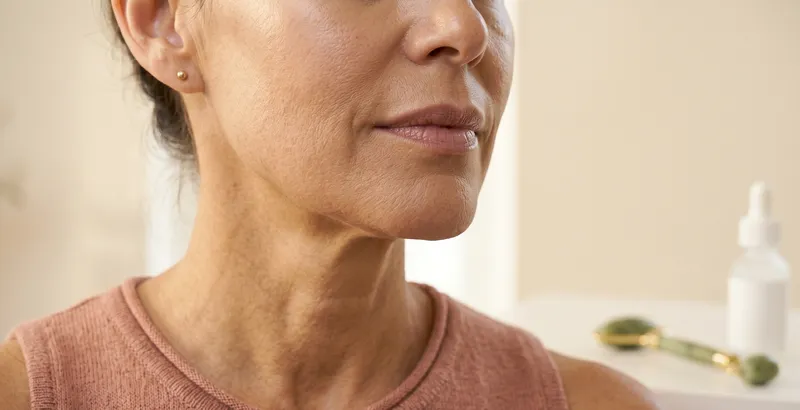
The science of skin aging is evolving rapidly — and for women navigating the skin changes that come with menopause and beyond, evidence-based skincare represents a fundamentally different approach: working with your skin's biology rather than against it.
Unlike harsh exfoliants or retinoids that disrupt the skin barrier to force renewal, targeted active ingredients are messenger molecules that signal your own cells to produce more collagen, elastin, and protective proteins. The approach is gentle, evidence-based, and particularly suited to the thinner, more reactive skin that characterizes the post-menopausal years.
Androgen Receptor Density and the Lower-Face Breakout Pattern
The jawline and lower face represent a unique dermatological zone where hormonal influences on sebaceous gland activity are most pronounced in adult women. This anatomical predilection is not coincidental—it reflects the embryological origin and receptor biology of pilosebaceous units in this region. Sebaceous glands along the mandibular line, chin, and lateral neck derive from mesenchymal tissue with particularly high expression of androgen receptors (AR), specifically the type 1 isoform that demonstrates enhanced binding affinity for dihydrotestosterone (DHT). Immunohistochemical studies have quantified AR density in facial skin, revealing that the lower third of the face contains approximately 2.5 times more androgen receptors per sebaceous gland unit than the forehead or mid-face regions. Furthermore, local 5-alpha-reductase type 1 enzyme activity—responsible for converting circulating testosterone to the far more potent DHT—is significantly elevated in jawline sebocytes compared to those in other facial areas, creating a zone of amplified androgenic signaling independent of systemic hormone levels.[1]
The pathophysiology of jawline acne involves a complex interplay between hormonal signaling, neural innervation, and local inflammatory cascades specific to this anatomical region. The lower face receives dense innervation from the mandibular branch of the trigeminal nerve, and neuropeptides released by these nerve endings—particularly substance P and corticotropin-releasing hormone (CRH)—directly stimulate sebocyte proliferation and lipogenesis through neurokinin-1 receptors and CRH receptor type 1. This creates a neuroendocrine feedback loop where psychological stress activates trigeminal nerve endings, which release neuropeptides that amplify local sebum production and inflammation specifically in the jawline distribution. Additionally, the jawline sebaceous glands exhibit unique lipid profiles with higher squalene and wax ester content compared to other facial zones, creating a microenvironment particularly favorable to Cutibacterium acnes biofilm formation. The combination of excess sebum, altered lipid composition, and enhanced inflammatory signaling creates a self-perpetuating cycle: C. acnes proliferation triggers innate immune activation via TLR2, leading to neutrophil recruitment and IL-8 release, which further damages follicular epithelium and promotes deeper inflammatory lesion formation characteristic of jawline acne.
Clinical research confirms that clinical presentation of hormonal jawline acne in adult women has distinctive features that aid diagnosis and guide treatment selection. Lesions typically present as deep-seated inflammatory papules, nodules, and cysts rather than the open and closed comedones more characteristic of T-zone acne. These lesions often lack a visible head or central point, reflecting their deep dermal origin in the lower portions of the pilosebaceous unit. The temporal pattern provides critical diagnostic information: true hormonal jawline acne demonstrates cyclical flaring in premenopausal women (typically 7-10 days premenstrually, corresponding to the luteal progesterone peak and subsequent withdrawal) and persistent or waxing-and-waning patterns in perimenopausal women experiencing irregular hormonal fluctuations. Importantly, the distribution may extend beyond the visible jawline to include the submandibular area, anterior neck, and the angle of the mandible—areas frequently overlooked during clinical examination. In women over 40, this pattern often coexists with early signs of skin laxity along the jawline, creating both cosmetic and psychological distress that compounds treatment-seeking behavior.
Targeted treatment of jawline-predominant hormonal acne requires strategies that address local androgen amplification while respecting the structural characteristics of mature skin in this high-motion area. Topical approaches should leverage the recently approved clascoterone cream 1% (Winlevi), which acts as a competitive androgen receptor inhibitor applied directly to affected areas, offering site-specific anti-androgen activity without systemic effects. For established lesions, intralesional triamcinolone acetonide (2.5-5 mg/mL, reduced from the standard 10 mg/mL to minimize atrophy risk in aging skin with naturally thinning dermis) provides rapid resolution of painful nodules. A combination protocol using adapalene 0.3%/benzoyl peroxide 2.5% gel on the jawline with separate application of azelaic acid 15% on surrounding areas addresses both follicular occlusion and post-inflammatory hyperpigmentation simultaneously. Systemic spironolactone at 100mg daily specifically targets jawline acne with superior efficacy compared to other distribution patterns, with one randomized trial demonstrating 85% reduction in inflammatory lesion count in the mandibular zone versus 62% reduction in non-mandibular facial acne. Procedural interventions including low-dose fractional radiofrequency microneedling (at reduced energy settings of 15-25mJ for mature skin) can address both active deep lesions and early scar formation while providing mild skin tightening benefits along the jawline.
Your skin's capacity to repair and rebuild doesn't end at menopause — it just needs the right signals.
— Dr. Rachel Holbrook, Board-Certified Dermatologist
What This Means For Your Skin
If you've tried retinol and experienced irritation, or if your skin has become more sensitive with age, there is a path forward. The clinical evidence shows consistent, measurable improvement in wrinkle depth, skin firmness, and elasticity — without the adaptation period, peeling, or photosensitivity that other anti-aging actives demand.
Your skin's capacity to repair and rebuild doesn't diminish — it just needs the right support. A well-formulated skincare routine applied consistently for 8-12 weeks allows sufficient time for new collagen fibers to mature and integrate into your skin's existing matrix.
The science is clear. The evidence is consistent. The results are measurable.
What happens next is up to you.