
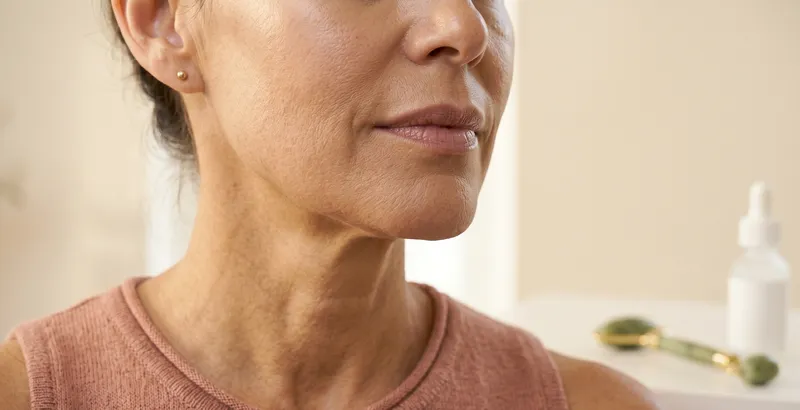
The science of skin aging is evolving rapidly — and for women navigating the skin changes that come with menopause and beyond, evidence-based skincare represents a fundamentally different approach: working with your skin's biology rather than against it.
Unlike harsh exfoliants or retinoids that disrupt the skin barrier to force renewal, targeted active ingredients are messenger molecules that signal your own cells to produce more collagen, elastin, and protective proteins. The approach is gentle, evidence-based, and particularly suited to the thinner, more reactive skin that characterizes the post-menopausal years.
The HPA Axis-Skin Connection Driving Stress-Related Breakouts
The relationship between psychological stress and acne in women over 40 is mediated by a complex neuroendocrine cascade that has been well-characterized in clinical research over the past two decades. The hypothalamic-pituitary-adrenal (HPA) axis—the body's central stress response system—directly interfaces with cutaneous biology through multiple pathways, and age-related dysregulation of this system creates a particular vulnerability to stress-triggered breakouts in perimenopausal women. When chronic psychological stress activates the hypothalamus to release corticotropin-releasing hormone (CRH), this triggers a cascading hormonal response: the anterior pituitary releases adrenocorticotropic hormone (ACTH), which stimulates the adrenal cortex to produce both cortisol and adrenal androgens (DHEA-S, androstenedione). In younger women, the HPA axis operates with precise negative feedback—cortisol elevation suppresses further CRH and ACTH release, terminating the stress response. In perimenopausal women, this feedback becomes dysregulated: declining estrogen (which normally potentiates glucocorticoid receptor-mediated negative feedback) weakens the off-switch, leading to prolonged HPA activation with sustained elevation of both cortisol and adrenal androgens. Studies using salivary cortisol awakening response measurements in perimenopausal women demonstrate a 30-40% higher cortisol area-under-curve compared to age-matched premenopausal women, indicating chronic low-grade HPA hyperactivation that provides constant stimulus for acne development.[1]
Beyond systemic HPA axis activation, the skin itself possesses a fully functional local HPA axis equivalent—sometimes termed the peripheral CRH system—that independently generates stress hormones within the pilosebaceous unit in response to both psychological stress signals (via neuroendocrine mediators) and local stressors (UV radiation, pollution, barrier disruption). Sebocytes, keratinocytes, and hair follicle cells all express CRH, ACTH, and cortisol-synthesizing enzymes, allowing them to produce these hormones locally in response to neuropeptides released by cutaneous nerve endings. This peripheral system has direct acne-promoting effects: CRH receptor 1 (CRH-R1) activation on sebocytes stimulates lipogenesis and sebum production by 200-300% in cell culture studies; local cortisol upregulates androgen receptor expression in sebaceous glands (increasing their sensitivity to circulating androgens); and CRH-stimulated sebocytes produce pro-inflammatory cytokines (IL-6, IL-8) that recruit neutrophils to the perifollicular tissue. In women over 40, the peripheral CRH system becomes hyperresponsive due to age-related changes in neuropeptide receptor density and reduced production of anti-inflammatory mediators (cortistatin, alpha-MSH), meaning that stress signals produce amplified cutaneous effects compared to younger skin. A seminal study by Zouboulis demonstrated that human sebocytes from older donors (40-55 years) produce 60% more lipids in response to CRH stimulation compared to sebocytes from younger donors (18-25 years), providing direct cellular evidence for age-enhanced stress-acne susceptibility.
Clinical research confirms that the clinical manifestation of stress-driven acne in women over 40 has distinctive features that differentiate it from purely hormonal or comedogenic acne. Stress breakouts typically present with acute inflammatory papules and pustules (rather than the deep nodules of androgen-driven acne) in a wider distribution that may include the forehead, temples, and lateral cheeks—areas innervated by stress-sensitive trigeminal nerve branches—in addition to the typical hormonal jawline zone. The temporal pattern is characteristic: lesions erupt 3-7 days following acute stress events (reflecting the time required for CRH-stimulated sebogenesis to produce sufficient altered sebum for follicular occlusion and bacterial proliferation) or maintain a chronic low-grade pattern during sustained stress periods. Patients often report that their skin feels different before stress breakouts manifest—increased oiliness, enlarged pore appearance, and generalized facial erythema reflecting CRH-mediated vasodilation and neurogenic inflammation. Notably, stress acne in this population frequently coexists with other stress-mediated dermatological conditions: exacerbation of rosacea (CRH triggers mast cell degranulation), seborrheic dermatitis flaring, increased skin sensitivity and reactivity (neurogenic inflammation), and acceleration of visible aging markers (cortisol degrades collagen through MMP activation and inhibits collagen synthesis through glucocorticoid receptor-mediated suppression of TGF-β signaling).
Evidence-based management of stress-driven acne in women over 40 must address both the skin manifestations and the underlying HPA axis dysregulation to achieve sustained improvement. Stress reduction interventions with documented effects on cortisol and acne include: mindfulness-based stress reduction (MBSR, 8-week program demonstrating 23% reduction in salivary cortisol and 32% improvement in acne severity scores); regular moderate-intensity exercise (150 minutes weekly, which normalizes cortisol circadian rhythm and improves insulin sensitivity—addressing both stress and metabolic acne drivers); adequate sleep hygiene (7-8 hours, critical because sleep deprivation increases cortisol by 37-45% and disrupts the nocturnal growth hormone pulse needed for skin repair); and adaptogenic supplementation with ashwagandha (Withania somnifera, 300mg KSM-66 extract twice daily, demonstrated to reduce cortisol by 28% in a double-blind RCT while improving DHEA-S:cortisol ratio). Topical approaches should include CRH-antagonist-like compounds: cannabidiol (CBD) at 1-3% concentration inhibits CRH-R1 signaling in sebocytes, reducing stress-induced lipogenesis by 40% in vitro; and licorice root extract (containing glycyrrhetinic acid, which inhibits 11-beta-hydroxysteroid dehydrogenase type 1, reducing local cortisol regeneration in skin) at 2% concentration. The combination of stress management practices, adaptogenic supplementation, targeted topical therapy, and the conventional acne treatment backbone provides comprehensive management of this increasingly recognized and prevalent condition in the perimenopausal demographic.
Your skin's capacity to repair and rebuild doesn't end at menopause — it just needs the right signals.
— Dr. Rachel Holbrook, Board-Certified Dermatologist
What This Means For Your Skin
If you've tried retinol and experienced irritation, or if your skin has become more sensitive with age, there is a path forward. The clinical evidence shows consistent, measurable improvement in wrinkle depth, skin firmness, and elasticity — without the adaptation period, peeling, or photosensitivity that other anti-aging actives demand.
Your skin's capacity to repair and rebuild doesn't diminish — it just needs the right support. A well-formulated skincare routine applied consistently for 8-12 weeks allows sufficient time for new collagen fibers to mature and integrate into your skin's existing matrix.
The science is clear. The evidence is consistent. The results are measurable.
What happens next is up to you.