
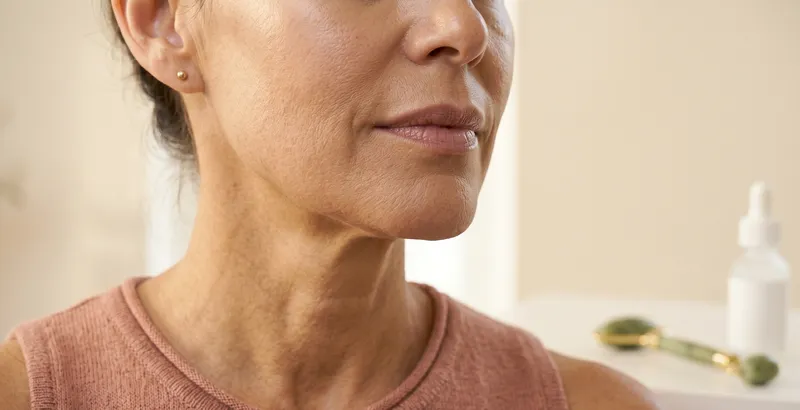
The science of skin aging is evolving rapidly — and for women navigating the skin changes that come with menopause and beyond, evidence-based skincare represents a fundamentally different approach: working with your skin's biology rather than against it.
Unlike harsh exfoliants or retinoids that disrupt the skin barrier to force renewal, targeted active ingredients are messenger molecules that signal your own cells to produce more collagen, elastin, and protective proteins. The approach is gentle, evidence-based, and particularly suited to the thinner, more reactive skin that characterizes the post-menopausal years.
The Perimenopause Hormone Shift That Triggers Late-Onset Breakouts
The sudden onset of acne in women over 40 who may have had clear skin for decades represents one of the most distressing dermatological complaints in this demographic, and its abrupt presentation often triggers anxiety about underlying pathology. In the majority of cases, this phenomenon directly correlates with the early perimenopause transition—a phase that can begin 8-10 years before actual menopause and is characterized by increasingly erratic ovarian function. During early perimenopause, the ovaries do not simply decline uniformly; rather, they oscillate unpredictably between periods of normal or even supraphysiological estrogen production (due to elevated FSH driving remaining follicles harder) and episodes of profound estrogen deficiency. These dramatic hormonal swings can shift sebaceous gland output by 30-40% within a single menstrual cycle, creating conditions for sudden acne flares in skin that previously maintained homeostasis. The threshold model of acne pathogenesis explains why this onset seems abrupt: cumulative subclinical changes in follicular keratinization, sebum composition, and microbial ecology build silently until a critical hormonal perturbation pushes the system past its compensatory capacity, resulting in seemingly overnight eruption of multiple inflammatory lesions.[1]
Beyond the primary hormonal driver, several age-related physiological changes converge around the fourth decade to create a perfect storm for acne development. Skin barrier function progressively deteriorates after age 35, with measurable decreases in ceramide production, natural moisturizing factor components, and antimicrobial peptide expression—particularly human beta-defensin 2 and cathelicidin LL-37. This compromised barrier simultaneously increases transepidermal water loss (promoting compensatory sebum overproduction) and reduces innate antimicrobial defense against C. acnes proliferation. Additionally, the skin microbiome undergoes significant shifts in composition during the perimenopausal years: metagenomic studies reveal decreased microbial diversity with relative expansion of pro-inflammatory C. acnes phylotypes (IA-1 and IA-2) and reduction in commensal competitors such as Staphylococcus epidermidis. The glycation of collagen and elastin fibers that accelerates in the 40s also affects the structural integrity of the pilosebaceous unit, potentially altering sebum drainage pathways and promoting follicular obstruction. These convergent factors explain why women who successfully navigated puberty, pregnancy, and their 30s without significant acne can suddenly develop treatment-resistant inflammatory disease.
Clinical research confirms that the diagnostic evaluation of sudden-onset acne after 40 must be thorough because, while perimenopause accounts for the majority of cases, this presentation can occasionally herald more significant endocrine pathology. Red flags warranting comprehensive investigation include rapid onset of severe cystic acne accompanied by hirsutism, temporal hair recession, clitoromegaly, deepening voice, or rapid weight changes—signs suggestive of androgen-secreting ovarian or adrenal tumors, which have peak incidence in the perimenopausal years. Late-onset congenital adrenal hyperplasia (nonclassical 21-hydroxylase deficiency) affects approximately 1-2% of women and may first manifest clinically under the amplifying conditions of perimenopause. Polycystic ovary syndrome (PCOS), previously undiagnosed, can also unmask during this period as metabolic components worsen with age-related insulin resistance. The recommended laboratory panel includes early morning (before 8 AM) total testosterone, free testosterone (by equilibrium dialysis, not calculated), DHEA-S, 17-hydroxyprogesterone, cortisol, prolactin, TSH, fasting insulin, and hemoglobin A1c. Pelvic ultrasound is indicated when testosterone exceeds 150 ng/dL or when clinical virilization is present.
Management of sudden-onset adult acne must address the underlying hormonal dysregulation while simultaneously treating active lesions and preventing the post-inflammatory hyperpigmentation and scarring that mature skin is particularly prone to. Unlike younger patients, women over 40 have reduced epidermal turnover (cell cycle extends from 28 days to 40-60 days), slower wound healing, and diminished collagen synthesis—meaning every inflammatory lesion carries higher risk of permanent textural change. A three-pronged approach is recommended: immediate lesion management with short courses of doxycycline (40mg modified-release, sub-antimicrobial dose) to rapidly suppress inflammation without antibiotic resistance concerns; concurrent initiation of topical retinoid therapy using the microencapsulated tretinoin 0.05% formulation that provides efficacy with reduced irritation potential for compromised mature barriers; and systemic hormonal modulation with spironolactone (starting at 25mg, titrating to 100-150mg based on response and potassium monitoring). For women experiencing concurrent vasomotor symptoms, initiation of HRT with an anti-androgenic progestin provides dual benefit. Patient counseling should emphasize the 8-12 week timeline for visible improvement and the maintenance nature of hormonal therapy, as discontinuation typically leads to recurrence within 3-6 months.
Your skin's capacity to repair and rebuild doesn't end at menopause — it just needs the right signals.
— Dr. Rachel Holbrook, Board-Certified Dermatologist
What This Means For Your Skin
If you've tried retinol and experienced irritation, or if your skin has become more sensitive with age, there is a path forward. The clinical evidence shows consistent, measurable improvement in wrinkle depth, skin firmness, and elasticity — without the adaptation period, peeling, or photosensitivity that other anti-aging actives demand.
Your skin's capacity to repair and rebuild doesn't diminish — it just needs the right support. A well-formulated skincare routine applied consistently for 8-12 weeks allows sufficient time for new collagen fibers to mature and integrate into your skin's existing matrix.
The science is clear. The evidence is consistent. The results are measurable.
What happens next is up to you.