
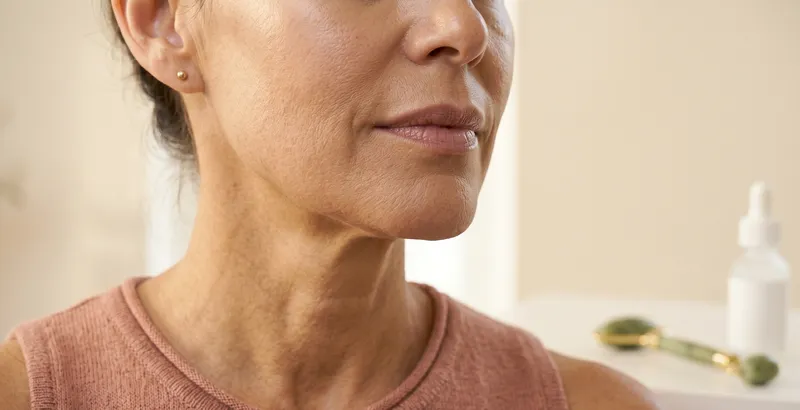
The science of skin aging is evolving rapidly — and for women navigating the skin changes that come with menopause and beyond, evidence-based skincare represents a fundamentally different approach: working with your skin's biology rather than against it.
Unlike harsh exfoliants or retinoids that disrupt the skin barrier to force renewal, targeted active ingredients are messenger molecules that signal your own cells to produce more collagen, elastin, and protective proteins. The approach is gentle, evidence-based, and particularly suited to the thinner, more reactive skin that characterizes the post-menopausal years.
Post-Pill Androgen Rebound Meets Perimenopause Hormone Decline
The resurgence of acne following oral contraceptive pill (OCP) discontinuation in women approaching or entering perimenopause represents a particularly complex clinical scenario involving the convergence of two distinct hormonal disruptions: post-pill androgen rebound and age-related estrogen decline. Combined oral contraceptives suppress acne through multiple mechanisms—they suppress ovarian androgen production via pituitary LH inhibition, increase hepatic SHBG production by 2-4 fold (dramatically reducing free androgen bioavailability), provide direct anti-androgenic effects (particularly pills containing drospirenone, cyproterone acetate, or dienogest), and deliver a stable exogenous estrogen dose that opposes androgenic signaling in skin. When these synthetic hormonal supports are withdrawn—whether due to age-related cardiovascular risk concerns (typically recommended at age 50 or with cardiovascular risk factors after 35), desire to assess natural menopausal status, or other medical considerations—the masking effect on underlying androgen activity is abruptly removed. In younger women, the post-pill acne flare typically resolves within 6-12 months as the hypothalamic-pituitary-ovarian axis re-equilibrates. However, in women discontinuing OCPs during perimenopause, natural ovarian estrogen production may be insufficient to restore the protective hormonal milieu that previously existed before pill use—resulting in persistent androgen-dominant acne that does not self-resolve.[1]
The pathophysiology of post-OCP acne in perimenopausal women involves a specific sequence of hormonal events that unfolds over 2-6 months following discontinuation. Within 2-4 weeks, SHBG levels begin declining from their OCP-elevated state (typically 200-400 nmol/L on the pill) toward their natural level—which in a perimenopausal woman may be significantly lower than the pre-pill baseline she had in her 20s or 30s, due to age-related decline in estrogen-driven SHBG production. Free testosterone rises proportionally to SHBG decline, often reaching levels 40-60% higher than what the woman experienced before starting the pill years or decades earlier. Simultaneously, the pituitary gland—suppressed by exogenous hormones—increases gonadotropin secretion in an attempt to stimulate the aging ovaries. The resulting FSH elevation drives remaining follicles to produce more estrogen in erratic bursts, but also stimulates theca cell androgen production disproportionately (since theca cells retain androgen-producing capacity longer than granulosa cells retain aromatase activity in the aging ovary). The clinical result is a 3-6 month window of significantly elevated free androgens with inadequate estrogen counterbalance—producing what patients describe as the worst acne they've experienced since adolescence, often more severe than their original pre-pill acne because the androgenic milieu is now genuinely worse than it was in their youth.
Clinical research confirms that the clinical management of post-OCP acne rebound in perimenopausal women requires a staged approach that bridges the hormonal transition while establishing sustainable long-term treatment. The critical first step is anticipatory counseling: women planning OCP discontinuation after age 40 should be warned about the high probability of acne flare and offered pre-emptive interventions. The 'bridge protocol' involves initiating spironolactone 50-100mg daily 4-6 weeks before pill discontinuation, allowing the anti-androgen to reach steady-state efficacy before the protective OCP effects wane. This prevents the dramatic acne surge that causes significant distress and scarring and often drives women to resume OCPs despite wishing to stop. For women who have already discontinued and are experiencing severe rebound acne, a combination of spironolactone 100-150mg daily (titrated over 2-4 weeks) plus doxycycline 40mg modified-release daily (for rapid inflammation control while waiting for spironolactone to take effect, typically discontinued after 8-12 weeks) provides effective management. The timeline expectation is crucial: spironolactone requires 3-4 months to achieve maximum anti-acne efficacy, and patients must understand that improvement is gradual to avoid treatment abandonment.
Long-term strategies for women who experienced OCP-controlled acne and are now navigating perimenopause without oral contraceptive support must address the fundamental question: what will maintain hormonal skin equilibrium going forward? For women with menopausal symptoms, hormone replacement therapy (HRT) with transdermal estradiol plus an anti-androgenic progestin (micronized progesterone has neutral androgenic effects; drospirenone or dienogest provide active anti-androgenic benefit) can replace the skin-protective effects of OCPs while addressing vasomotor symptoms, bone health, and cognitive function. Unlike OCPs, transdermal HRT does not increase SHBG to the same degree (hepatic first-pass effect is absent), so the anti-acne mechanism differs—relying more on direct estrogen receptor activation in skin and progesterone-mediated competition at the androgen receptor. For women who cannot or choose not to use HRT, long-term spironolactone (indefinite use is well-established, with some patients maintaining therapy for decades with excellent safety) combined with topical retinoid therapy and consistent skin barrier support provides effective ongoing management. The emerging option of low-dose topical estradiol (0.01% applied to facial skin) is under investigation for its ability to provide local anti-androgenic skin effects without systemic estrogenic exposure—potentially offering a targeted solution for post-OCP perimenopausal acne without the risks or complexities of systemic hormone therapy.
Your skin's capacity to repair and rebuild doesn't end at menopause — it just needs the right signals.
— Dr. Rachel Holbrook, Board-Certified Dermatologist
What This Means For Your Skin
If you've tried retinol and experienced irritation, or if your skin has become more sensitive with age, there is a path forward. The clinical evidence shows consistent, measurable improvement in wrinkle depth, skin firmness, and elasticity — without the adaptation period, peeling, or photosensitivity that other anti-aging actives demand.
Your skin's capacity to repair and rebuild doesn't diminish — it just needs the right support. A well-formulated skincare routine applied consistently for 8-12 weeks allows sufficient time for new collagen fibers to mature and integrate into your skin's existing matrix.
The science is clear. The evidence is consistent. The results are measurable.
What happens next is up to you.