
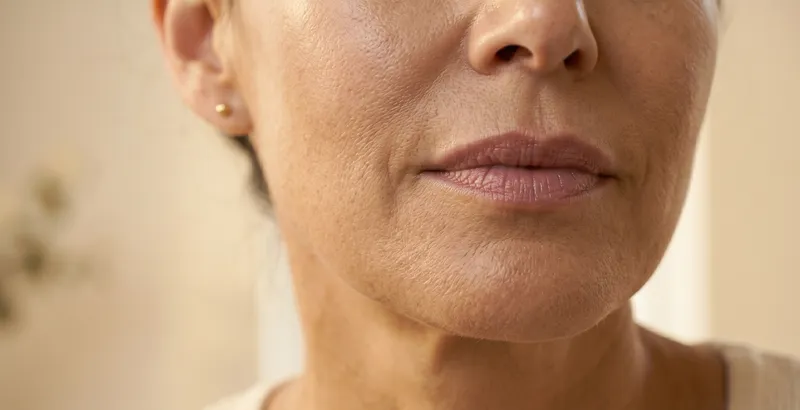
The science of skin aging is evolving rapidly — and for women navigating the skin changes that come with menopause and beyond, evidence-based skincare represents a fundamentally different approach: working with your skin's biology rather than against it.
Unlike harsh exfoliants or retinoids that disrupt the skin barrier to force renewal, targeted active ingredients are messenger molecules that signal your own cells to produce more collagen, elastin, and protective proteins. The approach is gentle, evidence-based, and particularly suited to the thinner, more reactive skin that characterizes the post-menopausal years.
The Complete Daily Protocol for Preventing and Treating Perioral Aging
Most women's skincare routines end at the lip border, leaving the perioral area — one of the most visible and rapidly aging facial zones — completely untreated. The lip care routine after 40 extends facial skincare to include the perioral skin, the lip border, and the lip surface itself, addressing the three simultaneous changes that age this area: perioral skin wrinkling (vertical lip lines), lip volume loss (thinning lips), and lip surface deterioration (dryness, cracking, loss of color). A dedicated lip care routine takes less than 2 minutes morning and evening but addresses a zone that disproportionately affects the perception of facial age.[1]
The morning lip care routine (60 seconds): Step 1 — Apply Argireline peptide lip serum to the perioral area and lip border. This reduces orbicularis oris contraction intensity throughout the day, slowing the mechanical deepening of lip lines during speaking and expression. Step 2 — Apply hyaluronic acid lip balm to the entire lip surface and slightly beyond the lip border. This provides hydration-mediated plumping that enhances lip fullness and softens the visibility of vertical lip lines. Choose a lip balm containing both HA and ceramides — the ceramides repair the lip surface barrier that is constantly disrupted by eating, drinking, and licking. Step 3 — Apply SPF to the perioral skin as part of your facial sunscreen application. Extend deliberately beyond the jawline of your usual SPF zone to cover the chin and perioral area completely. For the lips themselves, use an SPF lip balm (SPF 30+) as your everyday lip product — UV damage to the lip surface accelerates collagen loss and can cause actinic cheilitis.
Clinical research confirms that the evening lip care routine (90 seconds): Step 1 — Gentle cleansing. Remove any lip product using an oil-based cleanser applied with fingertips in gentle circular motions — never scrub or use rubbing wipes on the perioral area. Step 2 — Retinol application (2-3 evenings per week). Apply retinol 0.25% to the perioral skin using the ceramide sandwich method: thin layer of ceramide cream, retinol cream over it, thin layer of ceramide cream to seal. Stay 2-3mm from the lip border. Step 3 — On non-retinol evenings, apply peptide lip cream (Matrixyl 3000) to the perioral area and lip border. Step 4 — Every evening: apply a generous layer of ceramide-rich overnight lip treatment to the entire lip surface and perioral area. This provides 8 hours of barrier repair and hydration during the overnight repair window. For severe dryness or cracking: apply a thin layer of pure lanolin or medical-grade petrolatum over the ceramide treatment for occlusive sealing.
Weekly additions to the lip care routine: Once per week — gentle lip exfoliation using a soft lip scrub or a damp washcloth in small circular motions over the lip surface. This removes the accumulated dead cells that create the rough, flaky texture common on aging lips, improving the absorption of subsequent lip treatments and the appearance of lipstick application. Do not exfoliate on retinol nights — the retinol already provides chemical exfoliation to the perioral skin. Once per week — intensive lip mask. Apply a thick layer of hyaluronic acid lip serum followed by ceramide lip cream, then cover with a small piece of cling film for 10-15 minutes. This occlusive mini-treatment delivers concentrated hydration that produces visibly plumper, smoother lips immediately. Expected improvement from the consistent lip care routine: smoother, more hydrated lips at 2-4 weeks. Reduced lip line depth at 8-12 weeks. Progressive perioral rejuvenation continuing for 6-12 months. The women who maintain this routine consistently report that their lips look 5-8 years younger — fuller, smoother, with less visible lip lines and better lipstick application — compared to their pre-routine baseline.
Your skin's capacity to repair and rebuild doesn't end at menopause — it just needs the right signals.
— Dr. Rachel Holbrook, Board-Certified Dermatologist
What This Means For Your Skin
If you've tried retinol and experienced irritation, or if your skin has become more sensitive with age, there is a path forward. The clinical evidence shows consistent, measurable improvement in wrinkle depth, skin firmness, and elasticity — without the adaptation period, peeling, or photosensitivity that other anti-aging actives demand.
Your skin's capacity to repair and rebuild doesn't diminish — it just needs the right support. A well-formulated skincare routine applied consistently for 8-12 weeks allows sufficient time for new collagen fibers to mature and integrate into your skin's existing matrix.
The science is clear. The evidence is consistent. The results are measurable.
What happens next is up to you.