
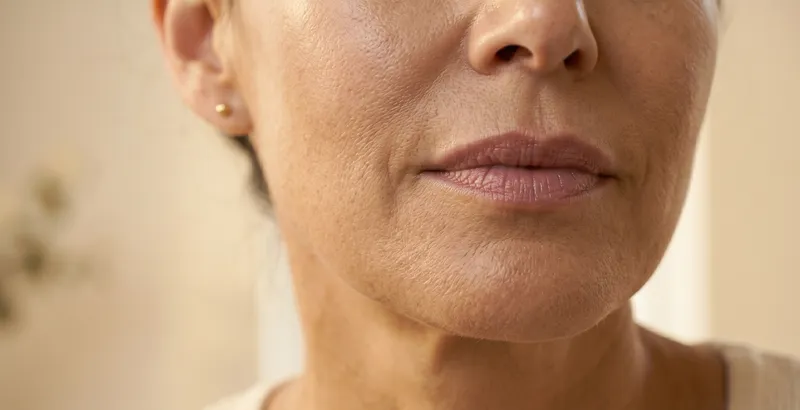
The science of skin aging is evolving rapidly — and for women navigating the skin changes that come with menopause and beyond, evidence-based skincare represents a fundamentally different approach: working with your skin's biology rather than against it.
Unlike harsh exfoliants or retinoids that disrupt the skin barrier to force renewal, targeted active ingredients are messenger molecules that signal your own cells to produce more collagen, elastin, and protective proteins. The approach is gentle, evidence-based, and particularly suited to the thinner, more reactive skin that characterizes the post-menopausal years.
The Topical Muscle Relaxant That Reduces Lip Line Formation Without Injections
Argireline (acetyl hexapeptide-3) is a neurotransmitter-inhibiting peptide that has earned the nickname 'topical Botox' for its ability to reduce muscle contraction intensity — though its mechanism and magnitude differ significantly from injectable botulinum toxin. Argireline works by inhibiting the SNARE complex, the protein machinery that enables neurotransmitter vesicles to fuse with the nerve terminal membrane and release acetylcholine into the neuromuscular junction. By partially blocking this vesicle fusion, Argireline reduces the amount of acetylcholine released at each nerve firing, which reduces the force of muscle contraction without paralyzing the muscle. For lip lines, this means the orbicularis oris still functions normally (you can still speak, eat, and express normally) but the peak contraction force is reduced by approximately 20-30%, decreasing the mechanical stress that deepens vertical lip wrinkles with every movement.[1]
The clinical evidence for Argireline in perioral wrinkles: a controlled study showed that 10% Argireline solution applied twice daily for 30 days produced a statistically significant 30% reduction in wrinkle depth compared to placebo, with the improvement visible by day 15 and continuing to increase through the study period. The effect is concentration-dependent — products containing less than 5% Argireline show minimal clinical benefit, while 10% shows robust results. Many commercial 'peptide lip treatments' list Argireline but at concentrations well below the therapeutic threshold. When evaluating products, look for acetyl hexapeptide-3 or acetyl hexapeptide-8 listed among the first 5-7 ingredients (indicating meaningful concentration).
Clinical research confirms that how Argireline complements retinol for lip lines: the two actives address different aspects of the same problem. Retinol rebuilds the collagen that provides structural resistance to wrinkling — it strengthens the dermis so it can better resist mechanical deformation. Argireline reduces the mechanical deformation itself — it decreases the contraction force that creates the wrinkles. The combination addresses both the resistance (collagen) and the force (muscle contraction), producing greater improvement than either alone. Clinical observation suggests that the combination of retinol + Argireline produces approximately 40-50% reduction in lip line depth at 12-16 weeks, compared to 25-30% for retinol alone and 20-25% for Argireline alone.
The practical Argireline lip protocol: apply a peptide lip serum or cream containing ≥5% Argireline (ideally 10%) to the perioral area morning and evening. Focus application on the upper lip where vertical lines originate, extending the product 1-2cm beyond the lip border into the surrounding skin where the orbicularis oris insertions create the deepest creases. Argireline is non-irritating and can be applied to the lip border itself without mucosal sensitivity concerns (unlike retinol, which must stay 2-3mm from the border). The layering order: in the morning, Argireline lip serum first (thin texture, absorbs quickly), then hyaluronic acid lip cream (hydration layer), then SPF. In the evening, Argireline lip serum first, then retinol (on retinol nights) or ceramide cream (on non-retinol nights). Argireline is compatible with all other actives and does not cause photosensitivity, making it safe for morning and evening use year-round. Expected timeline: the muscle-relaxing effect begins within 1-2 weeks of consistent twice-daily application. The collagen-stimulating effect of the peptide (Argireline also has mild collagen-stimulating properties through the same SNARE-related signaling) becomes visible at 8-12 weeks. Maximum improvement at 16-24 weeks of combined retinol + Argireline therapy.
Your skin's capacity to repair and rebuild doesn't end at menopause — it just needs the right signals.
— Dr. Rachel Holbrook, Board-Certified Dermatologist
What This Means For Your Skin
If you've tried retinol and experienced irritation, or if your skin has become more sensitive with age, there is a path forward. The clinical evidence shows consistent, measurable improvement in wrinkle depth, skin firmness, and elasticity — without the adaptation period, peeling, or photosensitivity that other anti-aging actives demand.
Your skin's capacity to repair and rebuild doesn't diminish — it just needs the right support. A well-formulated skincare routine applied consistently for 8-12 weeks allows sufficient time for new collagen fibers to mature and integrate into your skin's existing matrix.
The science is clear. The evidence is consistent. The results are measurable.
What happens next is up to you.