
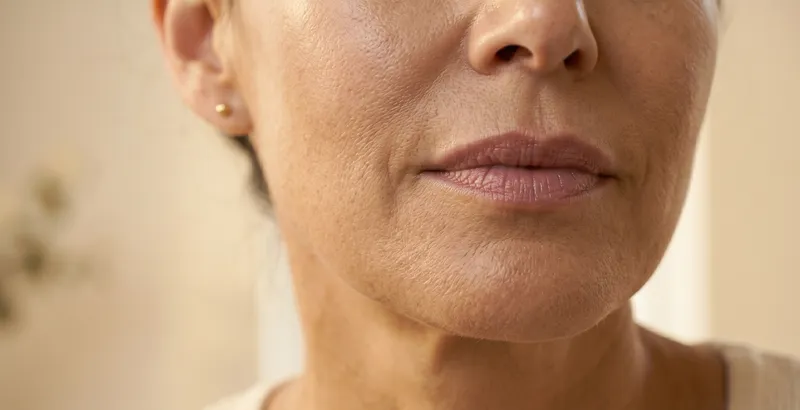
The science of skin aging is evolving rapidly — and for women navigating the skin changes that come with menopause and beyond, evidence-based skincare represents a fundamentally different approach: working with your skin's biology rather than against it.
Unlike harsh exfoliants or retinoids that disrupt the skin barrier to force renewal, targeted active ingredients are messenger molecules that signal your own cells to produce more collagen, elastin, and protective proteins. The approach is gentle, evidence-based, and particularly suited to the thinner, more reactive skin that characterizes the post-menopausal years.
Non-Injectable Approaches That Reduce Vertical Lip Wrinkles Through Collagen Rebuilding
Vertical lip lines — the fine wrinkles that radiate from the lip border into the surrounding skin — are among the most aging facial features because they disrupt the smooth lip contour that is a hallmark of youthful appearance. These lines form through a unique combination of mechanisms not found in other facial wrinkles: the orbicularis oris muscle (the circular muscle that controls lip movement) contracts thousands of times daily during speaking, eating, drinking, and facial expressions, creating repetitive mechanical stress on the overlying skin; the perioral skin has very few sebaceous glands compared to the cheeks and forehead, resulting in less natural lipid protection and a weaker barrier; and the lip border (vermilion border) is a transition zone between facial skin and mucosal tissue where structural support is inherently minimal. As collagen density declines with age and menopause, the perioral skin can no longer resist the mechanical deformation from muscle contraction, and permanent creases form along the lines of greatest stress.[1]
The distinction between lip lines and nasolabial folds is clinically important: nasolabial folds (covered in the existing mouth-wrinkles cluster) are deep creases running from the nose to the mouth corners caused by mid-face volume loss and gravitational descent. Lip lines are the fine, short, vertical wrinkles directly above and below the lip border caused by orbicularis oris contraction and perioral collagen depletion. The treatments overlap but have different emphases — nasolabial folds benefit most from volume restoration (filler), while lip lines respond better to surface-level collagen rebuilding and skin quality improvement. Many women have both, and addressing each appropriately produces the best overall perioral rejuvenation.
Clinical research confirms that the non-filler treatment protocol for lip lines targets collagen rebuilding in the perioral dermis: Step 1 — Retinol at 0.25-0.3% applied nightly to the perioral area (above the upper lip, below the lower lip, and extending 1-2cm beyond the lip border). The perioral skin tolerates slightly higher retinol concentrations than the periorbital area but lower than the cheeks. Use the ceramide sandwich method for the first 4 weeks. Step 2 — Peptide lip treatment (Matrixyl or acetyl hexapeptide-3/Argireline) applied morning and evening directly to the lip border and surrounding skin. Argireline is particularly relevant for lip lines because it reduces the micro-contraction intensity of the orbicularis oris muscle, decreasing the mechanical stress that deepens the creases. Step 3 — Hyaluronic acid lip serum applied to damp perioral skin, providing hydration-mediated plumping that immediately softens the appearance of fine lines while the slower collagen rebuilding proceeds.
Advanced non-injectable strategies: (1) Silicone lip pads worn overnight — medical-grade silicone pads placed over the upper lip area during sleep create an occlusive environment that hydrates the perioral skin deeply while providing gentle mechanical support that prevents the overnight compression that deepens lip lines during side sleeping. Clinical observation suggests 20-30% improvement in fine lip line depth after 8 weeks of nightly use. (2) Lip-specific SPF — the lip border and surrounding skin are frequently left unprotected when facial sunscreen is applied. UV exposure degrades the perioral collagen you're trying to rebuild. Apply facial SPF deliberately to the perioral area, including the lip border. (3) Lip primer with hyaluronic acid — used under lipstick, this creates a smooth barrier that prevents lipstick from bleeding into lip lines while providing ongoing hydration. Expected results from the non-filler protocol: fine lip lines show visible improvement at 8-12 weeks as retinol-stimulated collagen begins to mature. Moderate lip lines require 16-24 weeks for meaningful improvement. Deep, established lip lines (typically from decades of smoking or extensive sun damage) may improve 30-40% with topical treatment but may require professional intervention (laser resurfacing or micro-needling) for significant further improvement.
Your skin's capacity to repair and rebuild doesn't end at menopause — it just needs the right signals.
— Dr. Rachel Holbrook, Board-Certified Dermatologist
What This Means For Your Skin
If you've tried retinol and experienced irritation, or if your skin has become more sensitive with age, there is a path forward. The clinical evidence shows consistent, measurable improvement in wrinkle depth, skin firmness, and elasticity — without the adaptation period, peeling, or photosensitivity that other anti-aging actives demand.
Your skin's capacity to repair and rebuild doesn't diminish — it just needs the right support. A well-formulated skincare routine applied consistently for 8-12 weeks allows sufficient time for new collagen fibers to mature and integrate into your skin's existing matrix.
The science is clear. The evidence is consistent. The results are measurable.
What happens next is up to you.