
The science of skin aging is evolving rapidly — and for women navigating the skin changes that come with menopause and beyond, evidence-based skincare represents a fundamentally different approach: working with your skin's biology rather than against it.
Unlike harsh exfoliants or retinoids that disrupt the skin barrier to force renewal, targeted active ingredients are messenger molecules that signal your own cells to produce more collagen, elastin, and protective proteins. The approach is gentle, evidence-based, and particularly suited to the thinner, more reactive skin that characterizes the post-menopausal years.
Preventing Feathering Through Lip Primers, Technique, and Long-Term Line Reduction
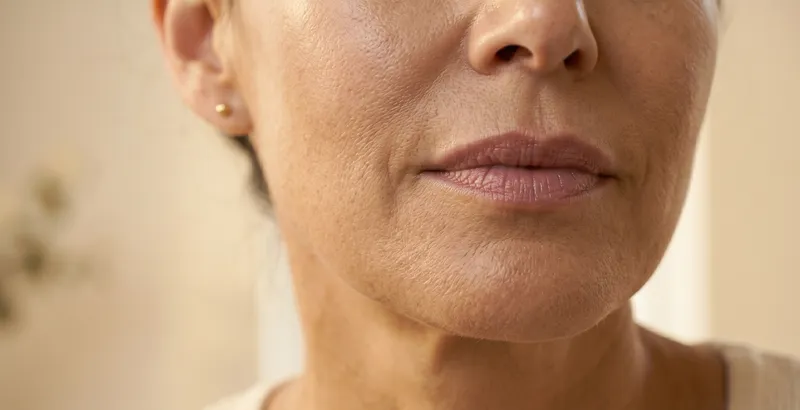
Lipstick bleeding — the migration of lip color into the fine vertical lines radiating from the lip border — is a cosmetic frustration that affects nearly every woman with perioral wrinkles, often forcing the abandonment of lip color entirely. The mechanism is simple physics: the vertical lip lines create capillary channels — tiny grooves in the skin surface that wick liquid through surface tension, exactly like a paper towel absorbs water through its fiber channels. Any lip product with a fluid component (which includes most lipsticks, glosses, and liquid lips) will follow these channels outward from the lip border, creating the feathered, bleeding appearance. Matte lipsticks bleed less because they have lower fluid content, but they emphasize the texture of dry, lined lips instead — trading one problem for another.[1]
The immediate cosmetic solutions work by blocking the capillary channels: (1) Lip liner applied around the entire lip border — not just the corners — creates a waxy barrier that blocks the channels where they originate at the vermilion border. Use a liner matching your natural lip color (not the lipstick color) so it looks natural as the lipstick wears. Apply with firm pressure, filling the lip lines where they intersect the lip border. (2) Lip primer containing silicone (dimethicone) fills the grooves of the lip lines with a smooth, non-absorptive surface that prevents wicking. Apply primer to the lip border and 5mm beyond, allow 30 seconds to set, then apply lipstick. (3) Setting technique — after applying lipstick, press a single-ply tissue against the lips (not blotting, pressing), then dust translucent powder over the tissue onto the lips. This sets the lipstick into a semi-matte finish that resists migration. (4) Product selection — creamy satin-finish lipsticks offer the best balance for lined lips: enough slip to apply smoothly without settling into texture, but enough body to resist bleeding.
Clinical research confirms that the long-term solution addresses the lines themselves: as the topical treatment protocol (retinol, peptides, hyaluronic acid) rebuilds perioral collagen and reduces the depth of vertical lip lines, the capillary channels become shallower and less effective at wicking pigment. Women who maintain consistent perioral treatment for 3-6 months typically report a significant reduction in lipstick bleeding — not because the lipstick changed, but because the channels are less deep. This structural improvement means less reliance on primers and liners, and the ability to wear a broader range of lip products including the glosses and sheers that are most aging-appropriate but most prone to bleeding on untreated lines.
The comprehensive lip line and lipstick strategy: Immediate (today) — lip liner around entire border, silicone lip primer, satin-finish lipstick, tissue-press setting technique. Short-term (4-8 weeks) — begin retinol 0.25% to perioral area nightly, peptide lip treatment morning and evening, HA lip serum for plumping. The active treatment makes the immediate cosmetic strategies work progressively better as the lines shallow. Medium-term (12-24 weeks) — visible reduction in lip line depth means lipstick stays in place longer with less primer, bleeding occurs later in the day or not at all with most formulas. Long-term (6+ months) — many women find they can reduce or eliminate the lip primer step entirely, wearing lipstick with just liner as the barrier. The lip lines are still present but shallow enough that capillary wicking is minimal. The transformation from 'I can't wear lipstick anymore' to 'lipstick stays perfectly' is one of the most psychologically rewarding outcomes of perioral treatment — restoring a makeup option that many women had resigned themselves to losing.
Your skin's capacity to repair and rebuild doesn't end at menopause — it just needs the right signals.
— Dr. Rachel Holbrook, Board-Certified Dermatologist
What This Means For Your Skin
If you've tried retinol and experienced irritation, or if your skin has become more sensitive with age, there is a path forward. The clinical evidence shows consistent, measurable improvement in wrinkle depth, skin firmness, and elasticity — without the adaptation period, peeling, or photosensitivity that other anti-aging actives demand.
Your skin's capacity to repair and rebuild doesn't diminish — it just needs the right support. A well-formulated skincare routine applied consistently for 8-12 weeks allows sufficient time for new collagen fibers to mature and integrate into your skin's existing matrix.
The science is clear. The evidence is consistent. The results are measurable.
What happens next is up to you.