
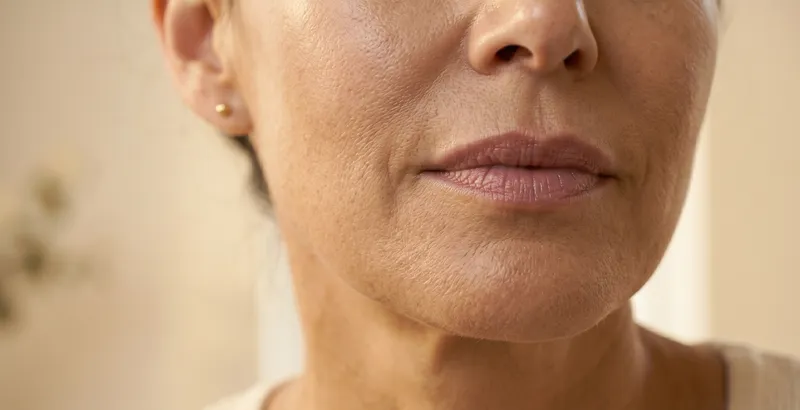
The science of skin aging is evolving rapidly — and for women navigating the skin changes that come with menopause and beyond, evidence-based skincare represents a fundamentally different approach: working with your skin's biology rather than against it.
Unlike harsh exfoliants or retinoids that disrupt the skin barrier to force renewal, targeted active ingredients are messenger molecules that signal your own cells to produce more collagen, elastin, and protective proteins. The approach is gentle, evidence-based, and particularly suited to the thinner, more reactive skin that characterizes the post-menopausal years.
The Most Effective Active Ingredient for Perioral Collagen Rebuilding
Retinol is the single most effective topical ingredient for upper lip wrinkles because it addresses both causes simultaneously: it stimulates new collagen production in the perioral dermis (rebuilding the structural support that prevents wrinkle formation) AND it accelerates epidermal turnover (clearing the accumulated thin, damaged surface cells that settle into the wrinkle grooves and make them more visible). No other topical ingredient provides this dual mechanism for the perioral area. Peptides stimulate collagen but don't accelerate turnover. AHAs accelerate turnover but don't significantly stimulate deep collagen production. Hyaluronic acid plumps but doesn't rebuild. Retinol does both, which is why clinical studies consistently show it produces the greatest improvement in perioral wrinkle depth among all topical interventions.[1]
The perioral retinol protocol requires specific adaptations because the upper lip area is more sensitive than the cheeks or forehead: the skin is thinner, has fewer oil glands, and is constantly moistened by saliva at the lip border (which can carry the retinol to the mucosal surface, causing irritation). Concentration: 0.25% retinol maximum for the perioral area — this is lower than the 0.5% typically used on the cheeks but sufficient for the thinner perioral dermis where penetration is more efficient. Application technique: apply a pea-sized amount of retinol cream to the upper lip area, staying 2-3mm away from the actual lip border to prevent migration onto the mucosa. Use the ring finger in gentle tapping motions — never drag product across the perioral area, as this mechanical stress contributes to the very wrinkles you're treating.
Clinical research confirms that the ceramide sandwich method is strongly recommended for perioral retinol: apply a thin layer of ceramide lip cream first, then the retinol, then another layer of ceramide cream. This buffered delivery reduces the peak irritation while maintaining dermal retinol delivery, and the ceramide layers protect the fragile perioral barrier from retinol-induced dryness. The introduction schedule: Week 1-2: once per week. Week 3-4: twice per week. Week 5-8: every other night. Week 9+: nightly if tolerated (many women find every-other-night is their long-term sweet spot for the perioral area). If peeling, redness, or burning occurs at any stage, drop back to the previous tolerated frequency for 2 weeks.
Expected results from perioral retinol: fine lip lines (early, shallow wrinkles that appeared recently) show visible improvement at 8-12 weeks — these respond fastest because they represent recent collagen loss that retinol can relatively quickly compensate for. Moderate lip lines (established wrinkles visible at rest, developed over years) show meaningful improvement at 16-24 weeks as cumulative collagen rebuilding reaches the threshold for visible change. Deep lip lines (prominent wrinkles from decades of mechanical stress and collagen loss) show 30-40% improvement at 24-36 weeks — enough to significantly soften the appearance and reduce lipstick bleeding, but topical retinol alone may not fully resolve deeply established creases. For deep lines, the combination of nightly retinol plus professional treatments (fractional laser resurfacing or micro-needling with growth factors, performed every 4-6 weeks for 3-4 sessions) produces the most complete improvement. The retinol ensures ongoing collagen stimulation between professional sessions, and the pre-treatment retinol use has been shown to enhance the results of laser and micro-needling by priming the fibroblasts for accelerated collagen production.
Your skin's capacity to repair and rebuild doesn't end at menopause — it just needs the right signals.
— Dr. Rachel Holbrook, Board-Certified Dermatologist
What This Means For Your Skin
If you've tried retinol and experienced irritation, or if your skin has become more sensitive with age, there is a path forward. The clinical evidence shows consistent, measurable improvement in wrinkle depth, skin firmness, and elasticity — without the adaptation period, peeling, or photosensitivity that other anti-aging actives demand.
Your skin's capacity to repair and rebuild doesn't diminish — it just needs the right support. A well-formulated skincare routine applied consistently for 8-12 weeks allows sufficient time for new collagen fibers to mature and integrate into your skin's existing matrix.
The science is clear. The evidence is consistent. The results are measurable.
What happens next is up to you.