
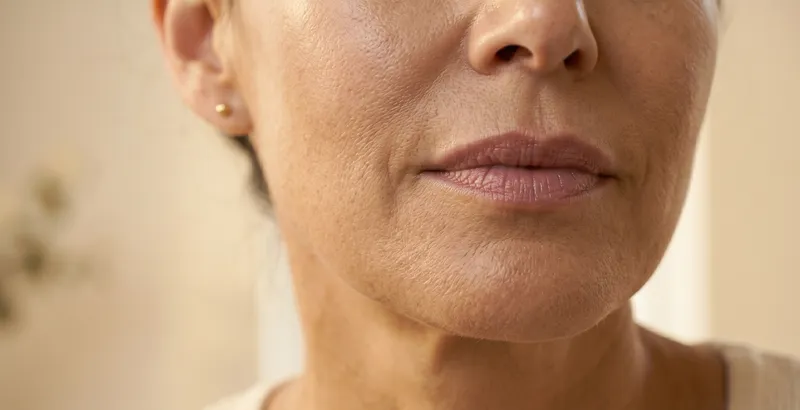
The science of skin aging is evolving rapidly — and for women navigating the skin changes that come with menopause and beyond, evidence-based skincare represents a fundamentally different approach: working with your skin's biology rather than against it.
Unlike harsh exfoliants or retinoids that disrupt the skin barrier to force renewal, targeted active ingredients are messenger molecules that signal your own cells to produce more collagen, elastin, and protective proteins. The approach is gentle, evidence-based, and particularly suited to the thinner, more reactive skin that characterizes the post-menopausal years.
Proactive Strategies That Delay Perioral Aging Before Deep Lines Form
The early 40s represent the optimal window for lip wrinkle prevention because perioral collagen decline is just beginning to accelerate but has not yet produced visible deep wrinkles. Women in their early 40s typically have fine, superficial lip lines that are visible only during certain lighting or expressions — the structural foundation is still largely intact but beginning to thin. Intervening at this stage preserves the existing collagen, stimulates new collagen production to compensate for the accelerating losses, and establishes habits that slow the mechanical stress contributing to line formation. The women who start perioral prevention in their early 40s consistently report less lip line severity in their 50s and 60s compared to peers who begin treatment only after deep lines have formed.[1]
The preventive protocol is gentler and less intensive than the treatment protocol for established wrinkles, reflecting the lesser degree of structural deficit: Retinol at 0.15-0.25% applied to the perioral area 2-3 times weekly (not nightly) — sufficient to maintain collagen stimulation and MMP suppression without the irritation risk of aggressive treatment. At this early stage, the goal is sustained low-level stimulation rather than intensive rebuilding. Peptide lip cream (Matrixyl 3000) applied daily — peptides provide continuous gentle collagen stimulation that complements the retinol on alternating nights. SPF 50 applied deliberately to the perioral area every morning — the single most impactful preventive measure. UV damage is the primary modifiable risk factor for perioral aging, and preventing UV-induced collagen degradation preserves more structural integrity than any treatment can rebuild.
Clinical research confirms that behavioral prevention strategies in the early 40s: (1) Hydration maintenance — begin using a ceramide lip cream morning and evening as a non-negotiable daily habit. The perioral barrier is weakening in the early 40s, and consistent ceramide application prevents the chronic dehydration cycle that accelerates wrinkle formation before the wrinkles are visible. (2) Straw avoidance — reduce or eliminate drinking through straws. The cumulative puckering motion over thousands of sips contributes to mechanical lip line formation. Switch to wide-mouth glasses and cups. (3) Sleep position awareness — side sleeping creates compression lines on the face that become permanent more quickly on aging perioral skin. Consider transitioning to back sleeping or using a face-cradling pillow. (4) Gentle skincare handling — avoid rubbing the perioral area when washing the face, removing makeup, or applying products. The thin perioral skin is vulnerable to mechanical stretching that contributes to wrinkle formation.
The investment-to-return calculation for early prevention: the preventive protocol requires 5 minutes per day and minimal product investment — retinol, peptide cream, ceramide cream, and SPF. This modest commitment in the early 40s delays the onset of visible lip lines by an estimated 5-10 years based on clinical observation, meaning the intensive treatment protocol (which is more time-consuming, more expensive, and less effective because it's fighting established structural damage) may not be needed until the late 50s or 60s instead of the late 40s. Additionally, early prevention means the inevitable lip lines that eventually develop will be shallower, responding better and faster to treatment when it's eventually needed. The bottom line for women in their early 40s: you don't need an aggressive lip wrinkle treatment regimen. You need a simple, consistent preventive routine — retinol 2-3 times weekly, peptide cream daily, ceramide barrier support, and SPF. This modest investment now pays compound dividends in preserved perioral collagen for decades.
Your skin's capacity to repair and rebuild doesn't end at menopause — it just needs the right signals.
— Dr. Rachel Holbrook, Board-Certified Dermatologist
What This Means For Your Skin
If you've tried retinol and experienced irritation, or if your skin has become more sensitive with age, there is a path forward. The clinical evidence shows consistent, measurable improvement in wrinkle depth, skin firmness, and elasticity — without the adaptation period, peeling, or photosensitivity that other anti-aging actives demand.
Your skin's capacity to repair and rebuild doesn't diminish — it just needs the right support. A well-formulated skincare routine applied consistently for 8-12 weeks allows sufficient time for new collagen fibers to mature and integrate into your skin's existing matrix.
The science is clear. The evidence is consistent. The results are measurable.
What happens next is up to you.