
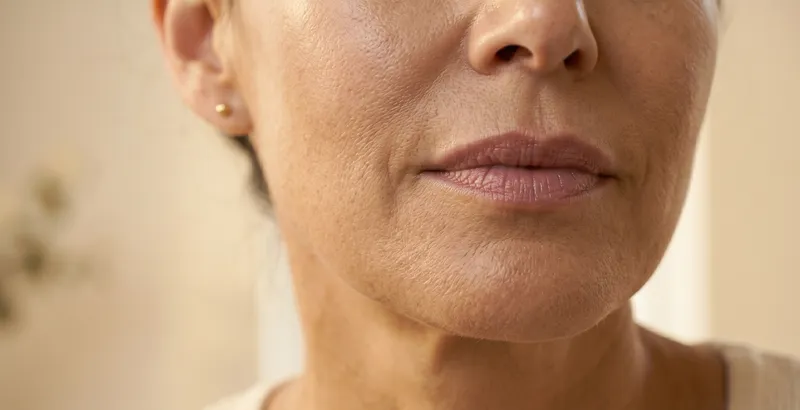
The science of skin aging is evolving rapidly — and for women navigating the skin changes that come with menopause and beyond, evidence-based skincare represents a fundamentally different approach: working with your skin's biology rather than against it.
Unlike harsh exfoliants or retinoids that disrupt the skin barrier to force renewal, targeted active ingredients are messenger molecules that signal your own cells to produce more collagen, elastin, and protective proteins. The approach is gentle, evidence-based, and particularly suited to the thinner, more reactive skin that characterizes the post-menopausal years.
How Hormonal Decline Accelerates Perioral Aging Faster Than Other Facial Areas
The rapid deepening of lip lines during menopause — often described by women as appearing 'overnight' — reflects the perioral area's particular sensitivity to estrogen withdrawal. The skin surrounding the mouth has among the highest density of estrogen receptors on the face, meaning that estrogen's collagen-stimulating effects were disproportionately supporting this area during reproductive years, and its withdrawal produces disproportionately rapid collagen decline. Research has shown that perioral collagen density drops 2-3 times faster during the menopausal transition than collagen density on the cheeks or forehead, creating a visible age gap where the mouth area looks older than the rest of the face. This differential aging is why many women report that their lip lines are the first facial wrinkles that make them feel visibly older.[1]
The compounding factors specific to menopausal lip line acceleration: (1) Estrogen-dependent lip volume loss — estrogen supports the subtle lip fullness that comes from adequate collagen and hyaluronic acid in the lip tissue. As estrogen declines, the lips thin (a universally noticed change during menopause), and thinner lips mean the vertical lip lines radiate from a smaller lip surface, making them more prominent relative to the lip size. (2) Perioral dryness — estrogen stimulates sebaceous gland activity, and the perioral area (already oil-poor) becomes even drier during menopause. Chronic perioral dryness makes the skin less resilient to mechanical stress, allowing wrinkles to form more easily and settle more permanently. (3) Reduced perioral blood flow — estrogen supports microvascular health, and its decline reduces blood flow to the perioral skin, slowing both nutrient delivery and the removal of metabolic waste that accelerates collagen degradation.
Clinical research confirms that the menopause-adapted lip line treatment protocol acknowledges that the perioral barrier is more compromised and the collagen deficit is more acute than in younger patients: Phase 1 (weeks 1-4) — Barrier recovery only. Apply ceramide lip cream morning and evening to stabilize the perioral barrier before introducing active ingredients. The menopausal perioral skin is often too compromised to tolerate retinol immediately — rushing into active treatment without barrier preparation leads to irritation that worsens the lines. Phase 2 (weeks 3-8) — Introduce Argireline peptide lip serum twice daily (non-irritating, immediate benefit from muscle relaxation). Add hyaluronic acid lip treatment applied to damp perioral skin (immediate plumping). Phase 3 (weeks 6-16) — Introduce retinol 0.25% once weekly using the ceramide sandwich method. Increase to twice weekly after 4 weeks if tolerated.
Phase 4 (weeks 12+) — Maintain the routine with retinol 2-3 times weekly, Argireline daily, HA daily, and ceramide barrier support continuously. At this point, the perioral collagen rebuilding is producing visible results, and the maintenance protocol prevents the re-acceleration of lip line deepening. For women on hormone replacement therapy (HRT): HRT has been shown to improve perioral collagen density, and women on HRT typically see faster and more complete response to topical lip line treatment because the systemic estrogen support complements the topical collagen stimulation. However, HRT is a medical decision with considerations beyond cosmetics, and topical treatment alone produces meaningful improvement regardless of HRT status. Expected menopausal lip line improvement: 30-50% reduction in fine-to-moderate lip line depth at 16-24 weeks of consistent protocol. The improvement is progressive — continuing treatment beyond 24 weeks produces further gradual improvement as cumulative collagen rebuilding reaches deeper layers. Women who begin treatment in early perimenopause (when collagen loss is just accelerating) achieve better outcomes than those who begin years after menopause, because more perioral collagen remains to preserve and build upon.
Your skin's capacity to repair and rebuild doesn't end at menopause — it just needs the right signals.
— Dr. Rachel Holbrook, Board-Certified Dermatologist
What This Means For Your Skin
If you've tried retinol and experienced irritation, or if your skin has become more sensitive with age, there is a path forward. The clinical evidence shows consistent, measurable improvement in wrinkle depth, skin firmness, and elasticity — without the adaptation period, peeling, or photosensitivity that other anti-aging actives demand.
Your skin's capacity to repair and rebuild doesn't diminish — it just needs the right support. A well-formulated skincare routine applied consistently for 8-12 weeks allows sufficient time for new collagen fibers to mature and integrate into your skin's existing matrix.
The science is clear. The evidence is consistent. The results are measurable.
What happens next is up to you.