
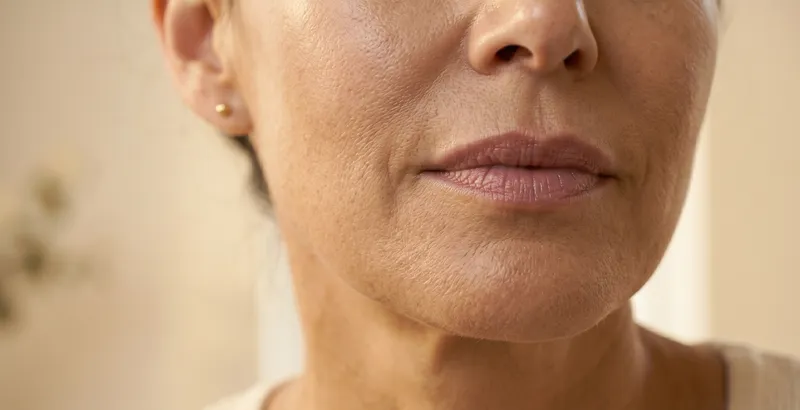
The science of skin aging is evolving rapidly — and for women navigating the skin changes that come with menopause and beyond, evidence-based skincare represents a fundamentally different approach: working with your skin's biology rather than against it.
Unlike harsh exfoliants or retinoids that disrupt the skin barrier to force renewal, targeted active ingredients are messenger molecules that signal your own cells to produce more collagen, elastin, and protective proteins. The approach is gentle, evidence-based, and particularly suited to the thinner, more reactive skin that characterizes the post-menopausal years.
Why Vertical Lip Wrinkles Develop Without Smoking and What Actually Causes Them
The term 'smoker's lines' is misleading because it implies that smoking is the primary or exclusive cause of vertical upper lip wrinkles. While smoking does accelerate perioral wrinkling (through direct chemical damage to collagen, chronic puckering motion, and reduced blood flow), the majority of women who develop upper lip lines have never smoked. The actual causes are universal aging mechanisms that affect every woman to some degree: (1) Orbicularis oris contraction — this circular muscle is used during every speaking sound, every sip through a straw or water bottle, every kiss, and countless unconscious facial expressions. Over 40-50 years, these billions of micro-contractions create mechanical fatigue in the overlying skin. (2) Perioral collagen decline — the perioral skin loses collagen at the same rate as other facial skin, but the impact is magnified because the perioral dermis is thinner and has less structural reserve. (3) UV damage — the upper lip protrudes slightly from the facial plane and receives significant direct UV exposure, particularly during outdoor activities. (4) Estrogen decline — the perioral area has high estrogen receptor density, and menopausal estrogen withdrawal accelerates collagen loss specifically in this region.[1]
The non-smoker's lip line timeline: most women begin to notice fine vertical lip lines in their early-to-mid 40s, with progression accelerating during perimenopause. By 55-60, moderate lip lines are present in virtually all women regardless of smoking history. The lines typically appear on the upper lip first (because the upper orbicularis oris contracts more forcefully during speech) and later develop on the lower lip. Genetic factors influence the timing: women with naturally thin lips, light skin (less melanin protection against UV), and strong orbicularis oris muscle activity (expressive speakers, musicians who play wind instruments) develop lip lines earlier. The emotional frustration of being told you have 'smoker's lines' when you've never smoked is common — these are more accurately called perioral rhytides or vertical lip lines.
Clinical research confirms that treatment for non-smoker lip lines follows the same protocol as general lip line treatment, with the important advantage that non-smokers have better perioral blood supply (smoking constricts blood vessels permanently, reducing nutrient delivery to the skin). This means non-smoker lip lines typically respond faster and more completely to topical treatment. The protocol: retinol 0.25% applied nightly to the perioral area using the ceramide sandwich method (critical — the perioral skin is sensitive and retinol without buffering frequently causes peeling and irritation around the mouth). Peptide lip cream (Matrixyl 3000 or Argireline) applied morning and evening for collagen stimulation and muscle relaxation. Hyaluronic acid lip serum for hydration-mediated plumping. SPF applied deliberately to the perioral area (most women skip this zone).
Behavioral modifications that slow lip line progression: (1) Reduce straw use — drinking through straws creates the same puckering motion as smoking, repeatedly contracting the orbicularis oris. Switch to sipping directly from cups and glasses. (2) Reduce water bottle lip-pursing — the narrow opening of most water bottles requires lip pursing. Use wide-mouth bottles or cups. (3) Sleep position — side sleeping compresses the face against the pillow, and the perioral area is particularly vulnerable to sleep-induced creasing. Back sleeping or a specialty pillow that supports the face without compressing the mouth area reduces overnight mechanical deepening of lip lines. (4) Hydration — chronic dehydration concentrates in the perioral area (few sebaceous glands = less natural moisture retention), and dehydrated perioral skin wrinkles more easily. Topical hydration (HA + ceramide) morning and evening provides continuous moisture that keeps the perioral skin more resilient to mechanical stress. Expected results for non-smoker lip lines: 40-60% visible improvement at 16-24 weeks with consistent topical treatment — generally better outcomes than smoker lip lines due to superior perioral blood supply and the absence of ongoing chemical damage.
Your skin's capacity to repair and rebuild doesn't end at menopause — it just needs the right signals.
— Dr. Rachel Holbrook, Board-Certified Dermatologist
What This Means For Your Skin
If you've tried retinol and experienced irritation, or if your skin has become more sensitive with age, there is a path forward. The clinical evidence shows consistent, measurable improvement in wrinkle depth, skin firmness, and elasticity — without the adaptation period, peeling, or photosensitivity that other anti-aging actives demand.
Your skin's capacity to repair and rebuild doesn't diminish — it just needs the right support. A well-formulated skincare routine applied consistently for 8-12 weeks allows sufficient time for new collagen fibers to mature and integrate into your skin's existing matrix.
The science is clear. The evidence is consistent. The results are measurable.
What happens next is up to you.