
The science of skin aging is evolving rapidly — and for women navigating the skin changes that come with menopause and beyond, evidence-based skincare represents a fundamentally different approach: working with your skin's biology rather than against it.
Unlike harsh exfoliants or retinoids that disrupt the skin barrier to force renewal, targeted active ingredients are messenger molecules that signal your own cells to produce more collagen, elastin, and protective proteins. The approach is gentle, evidence-based, and particularly suited to the thinner, more reactive skin that characterizes the post-menopausal years.
Restoring Lip Fullness Through Hydration, Collagen Stimulation, and Strategic Enhancement
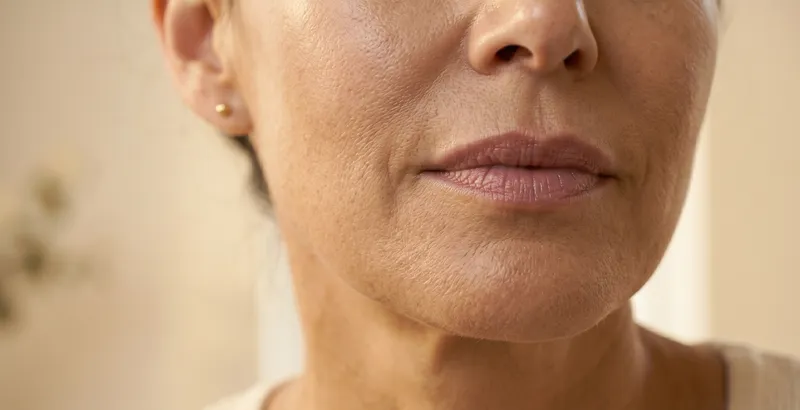
Lip thinning during menopause is one of the most universally noticed — and most distressing — facial changes women experience. The lips lose volume through three concurrent mechanisms: (1) Collagen depletion — the lip tissue (vermilion) contains collagen that provides structural support and fullness. As menopausal collagen loss accelerates, the lips literally flatten. (2) Hyaluronic acid decline — the lips contain significant HA that binds water and provides the plump, hydrated appearance of youthful lips. Estrogen stimulates HA production, and its decline reduces the water-binding capacity of lip tissue. (3) Fat pad atrophy — small fat deposits within and around the lips contribute to fullness, and these atrophy during the generalized facial fat redistribution of menopause. The combined result: lips that appear thinner, flatter, drier, and less defined, with the lip border (vermilion border) becoming less distinct as the contrast between lip and surrounding skin diminishes.[1]
Natural plumping strategies target the modifiable components: Hydration plumping — hyaluronic acid applied topically to the lips draws water into the lip tissue, creating immediate volumization. For maximum effect: apply HA lip serum to damp lips (mist with water first), then seal immediately with a ceramide or beeswax-based lip balm. The HA attracts water while the balm prevents its evaporation. Multi-molecular-weight HA formulations work best because the smaller molecules penetrate the lip tissue while the larger molecules sit on the surface creating a hydrating film. Peptide-mediated collagen rebuilding — Matrixyl 3000 or palmitoyl tripeptide-1 applied to the lip surface and border morning and evening stimulates collagen production in the lip tissue. The improvement is gradual (8-16 weeks) but structural — the lips become genuinely fuller rather than temporarily plumped.
Clinical research confirms that cosmetic enhancement strategies: (1) Lip-plumping glosses containing capsaicin or menthol — these ingredients create mild irritation that causes temporary vasodilation and swelling of the lip tissue, producing visible plumping that lasts 1-4 hours. The effect is purely cosmetic and temporary but provides an immediate confidence boost for specific occasions. Use sparingly — chronic irritation can actually thin the lip tissue over time. (2) Lip liner technique for perceived volume — overdrawing the lip border by 1mm with a liner matching the natural lip color creates the optical illusion of fuller lips. Follow with a satin lipstick in a shade similar to the liner. This technique is more effective than it sounds — the 1mm overdraw is subtle enough to look natural while meaningfully increasing the perceived lip area. (3) Strategic color — lighter lip colors and glossy finishes reflect light and create the appearance of volume, while dark matte colors absorb light and make thin lips look thinner.
The comprehensive lip volume protocol: Morning — HA lip serum on damp lips, sealed with ceramide SPF lip balm. Peptide lip cream applied to lip border and surrounding skin. Evening — retinol 0.25% to perioral skin 2-3 nights per week (this supports the collagen in the lip border area). Peptide lip cream to lip surface and border nightly. Ceramide overnight lip treatment as the final step. Weekly — overnight HA mask with occlusive seal (ceramide balm or silicone lip patch). Expected lip volume improvement: the hydration-mediated plumping is visible immediately but temporary without maintenance. The collagen-mediated structural fullness begins at 8-12 weeks and is sustainable with continued treatment. Most women report a noticeable improvement in lip fullness at 12-16 weeks — not a return to their 25-year-old lips, but a visible restoration that makes the lips look healthier, more defined, and more youthful. The improvement is typically described as looking 'like my lips 5-8 years ago' — a natural, age-appropriate enhancement rather than an artificial augmentation.
Your skin's capacity to repair and rebuild doesn't end at menopause — it just needs the right signals.
— Dr. Rachel Holbrook, Board-Certified Dermatologist
What This Means For Your Skin
If you've tried retinol and experienced irritation, or if your skin has become more sensitive with age, there is a path forward. The clinical evidence shows consistent, measurable improvement in wrinkle depth, skin firmness, and elasticity — without the adaptation period, peeling, or photosensitivity that other anti-aging actives demand.
Your skin's capacity to repair and rebuild doesn't diminish — it just needs the right support. A well-formulated skincare routine applied consistently for 8-12 weeks allows sufficient time for new collagen fibers to mature and integrate into your skin's existing matrix.
The science is clear. The evidence is consistent. The results are measurable.
What happens next is up to you.