
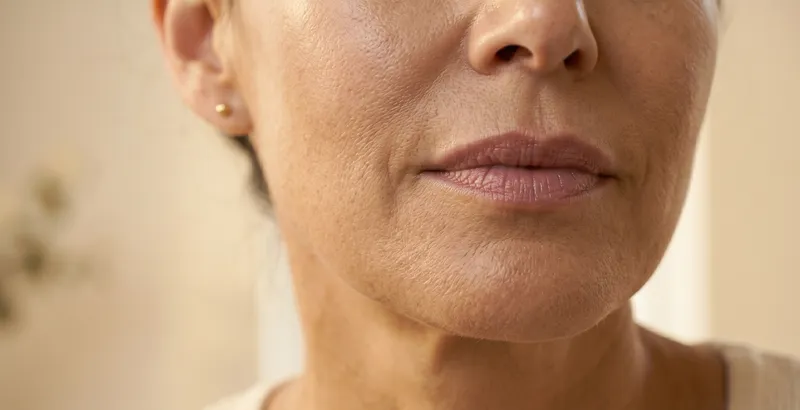
The science of skin aging is evolving rapidly — and for women navigating the skin changes that come with menopause and beyond, evidence-based skincare represents a fundamentally different approach: working with your skin's biology rather than against it.
Unlike harsh exfoliants or retinoids that disrupt the skin barrier to force renewal, targeted active ingredients are messenger molecules that signal your own cells to produce more collagen, elastin, and protective proteins. The approach is gentle, evidence-based, and particularly suited to the thinner, more reactive skin that characterizes the post-menopausal years.
When Topical Treatment Is Sufficient and When Injectable Filler Provides Better Results
The decision between topical treatment and injectable filler for lip lines depends on the depth and severity of the wrinkles, the timeline for desired improvement, and the willingness to maintain ongoing treatment. These are complementary approaches, not competing ones — understanding what each can and cannot achieve guides the most satisfying outcome. Topical treatment (retinol, peptides, HA) works by rebuilding collagen in the perioral dermis, thickening the skin so it resists mechanical wrinkling more effectively. This addresses the root cause (collagen depletion) but requires time — 12-24 weeks for visible improvement. Injectable filler (typically thin hyaluronic acid like Restylane Silk or Belotero Balance) works by physically filling the wrinkle groove from beneath, immediately smoothing the line. This addresses the symptom (the visible wrinkle) but requires periodic renewal as the filler is metabolized (6-12 months for perioral filler).[1]
When topical treatment alone is sufficient: fine lip lines that are barely visible at rest and prominent only during certain expressions or lighting. Lines that developed recently (within the past 1-3 years) and haven't deepened significantly. Women who prefer a gradual, natural-looking improvement over immediate change. Women in their 40s whose lines are still shallow enough to respond to collagen rebuilding. Expected topical improvement for these cases: 40-60% reduction in line visibility at 16-24 weeks. When filler should be considered: moderate-to-deep lip lines that are visible at rest and create channels that bleed lipstick consistently. Lines that have been present and deepening for 5+ years, where significant collagen loss has occurred. Women who want immediate improvement for an upcoming event or who have tried 6+ months of topical treatment with insufficient results. Lines caused primarily by volume loss (thin lips that have lost fullness) rather than solely by mechanical creasing.
Clinical research confirms that the optimal combined approach: start with topical treatment for 3-6 months to optimize the perioral skin quality. This pre-treatment improves the results of subsequent filler by creating a healthier, thicker, more hydrated skin canvas for the filler to work within. After topical optimization, if residual lines are still cosmetically significant, consult with an experienced injector for perioral filler. Continue topical treatment after filler — the ongoing collagen stimulation extends the longevity of filler results (women who maintain topical retinol and peptide treatment typically need filler touch-ups every 9-12 months versus 6-8 months for those who rely on filler alone) and progressively reduces the amount of filler needed at each session.
The cost-benefit reality: topical treatment is lower cost (monthly product investment of approximately the cost of one filler syringe per 6-12 months) with gradual, sustained structural improvement. Filler is higher cost (per session, typically renewed every 6-12 months) with immediate, dramatic smoothing of specific lines. For women with fine lip lines: topical treatment alone is usually cost-effective and sufficient. For women with moderate lines: the combination approach (topical foundation + selective filler for the deepest lines) produces the best balance of cost, result, and maintenance. For women with deep, established lines: filler provides the primary visible improvement, with topical treatment serving as the essential maintenance that extends filler results. The women who report the highest satisfaction are those who understand that topical treatment and filler address different aspects of the same problem — structure versus volume — and use each for its strength.
Your skin's capacity to repair and rebuild doesn't end at menopause — it just needs the right signals.
— Dr. Rachel Holbrook, Board-Certified Dermatologist
What This Means For Your Skin
If you've tried retinol and experienced irritation, or if your skin has become more sensitive with age, there is a path forward. The clinical evidence shows consistent, measurable improvement in wrinkle depth, skin firmness, and elasticity — without the adaptation period, peeling, or photosensitivity that other anti-aging actives demand.
Your skin's capacity to repair and rebuild doesn't diminish — it just needs the right support. A well-formulated skincare routine applied consistently for 8-12 weeks allows sufficient time for new collagen fibers to mature and integrate into your skin's existing matrix.
The science is clear. The evidence is consistent. The results are measurable.
What happens next is up to you.