
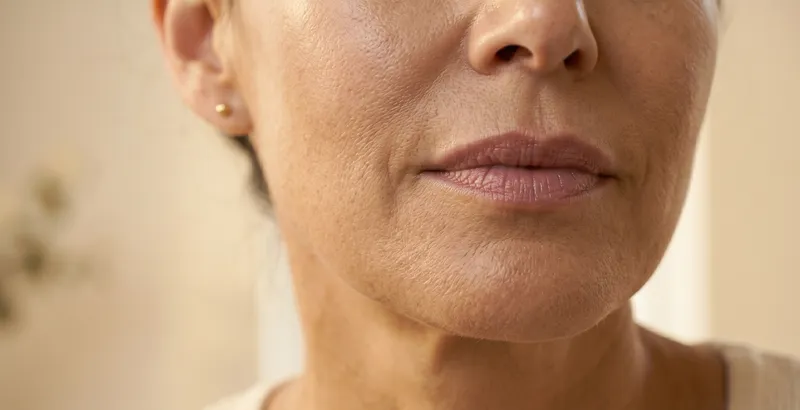
The science of skin aging is evolving rapidly — and for women navigating the skin changes that come with menopause and beyond, evidence-based skincare represents a fundamentally different approach: working with your skin's biology rather than against it.
Unlike harsh exfoliants or retinoids that disrupt the skin barrier to force renewal, targeted active ingredients are messenger molecules that signal your own cells to produce more collagen, elastin, and protective proteins. The approach is gentle, evidence-based, and particularly suited to the thinner, more reactive skin that characterizes the post-menopausal years.
How Occlusive Silicone Pads Reduce Lip Line Depth Through Overnight Hydration
Silicone lip patches — medical-grade silicone adhesive pads placed over the perioral area during sleep — have gained popularity as an overnight lip line treatment based on a sound dermatological principle: occlusion. When silicone is placed against the skin, it creates a sealed environment that prevents transepidermal water loss almost completely. The skin beneath the silicone patch retains all the moisture it produces naturally during sleep, plus any treatment products applied before the patch. Over 6-8 hours of overnight wear, the perioral dermis becomes deeply, maximally hydrated — and this hydration produces measurable effects. Hydrated collagen fibers swell slightly, increasing dermal volume and reducing wrinkle depth. Hydrated keratinocytes plump and smooth the skin surface. The sustained moisture environment also supports the nocturnal repair processes — growth hormone-mediated collagen synthesis peaks during sleep, and a hydrated dermis responds more robustly to this repair signal.[1]
The evidence for silicone patches: while large randomized controlled trials specific to lip patches are limited, the broader literature on occlusive silicone therapy (extensively studied for scar treatment) consistently demonstrates that silicone occlusion increases dermal hydration, improves collagen organization, and reduces the depth of skin surface irregularities. Clinical observation from dermatologists and consistent user experience reports suggest that overnight silicone lip patches produce 20-30% reduction in fine lip line depth after 6-8 weeks of nightly use. The improvement is cumulative — the first night produces visible but temporary improvement (gone by afternoon), but after weeks of nightly use, the sustained hydration produces structural changes that persist even during the day.
Clinical research confirms that how to use silicone lip patches optimally: (1) Apply after your evening perioral treatment routine — cleanse, apply retinol or peptide cream, apply ceramide cream, then place the silicone patch over the upper lip area. The patch traps the treatment products against the skin, enhancing their absorption and prolonging their contact time from 1-2 hours (normal absorption) to 6-8 hours (overnight occlusion). (2) Choose medical-grade silicone patches specifically designed for the perioral area — generic silicone sheets can be cut to size but may not conform well to the lip contour. The patch should cover the area from just below the nose to the lip border, extending slightly beyond the mouth corners where lip lines typically radiate. (3) Clean and dry the patches after each use — most medical-grade silicone patches are reusable for 15-30 uses before the adhesive diminishes.
The practical integration of silicone patches into the lip care protocol: nightly use provides maximum benefit, but even 3-4 nights per week produces meaningful improvement. On retinol nights (when perioral irritation risk is highest), the silicone patch serves double duty — it enhances retinol absorption while also providing a physical barrier that prevents the retinol from rubbing off onto the pillow. For women who find nightly patch wear uncomfortable or disruptive to sleep, wearing the patch for 2-3 hours before bedtime (while reading, watching TV, etc.) and removing before sleep provides a substantial portion of the occlusive benefit without the overnight commitment. Expected results: immediate (morning-of) — visibly plumper, smoother perioral skin with reduced lip line visibility. The effect lasts 4-8 hours as the skin gradually dehydrates. After 2-4 weeks of consistent use — the morning improvement becomes more dramatic and lasts longer into the day, indicating that cumulative hydration is producing structural changes. After 6-8 weeks — a baseline improvement persists even on mornings when the patch wasn't worn the night before, confirming lasting structural change. The combination of silicone patches with retinol and peptide treatment produces greater improvement than either approach alone — the patches enhance product absorption while providing the hydration that is essential for optimal collagen synthesis.
Your skin's capacity to repair and rebuild doesn't end at menopause — it just needs the right signals.
— Dr. Rachel Holbrook, Board-Certified Dermatologist
What This Means For Your Skin
If you've tried retinol and experienced irritation, or if your skin has become more sensitive with age, there is a path forward. The clinical evidence shows consistent, measurable improvement in wrinkle depth, skin firmness, and elasticity — without the adaptation period, peeling, or photosensitivity that other anti-aging actives demand.
Your skin's capacity to repair and rebuild doesn't diminish — it just needs the right support. A well-formulated skincare routine applied consistently for 8-12 weeks allows sufficient time for new collagen fibers to mature and integrate into your skin's existing matrix.
The science is clear. The evidence is consistent. The results are measurable.
What happens next is up to you.