
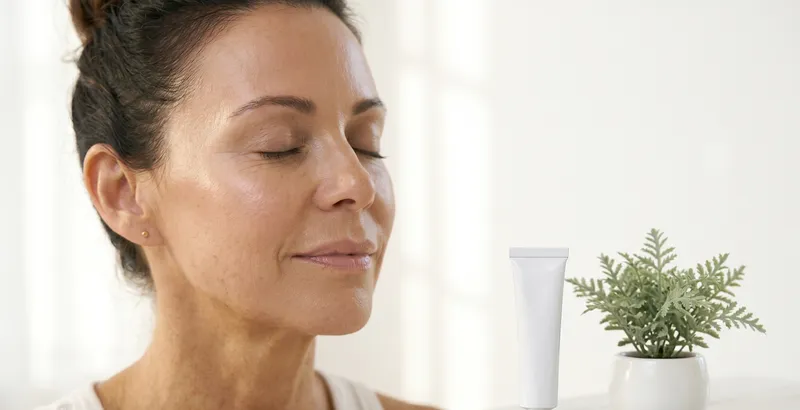
The science of skin aging is evolving rapidly — and for women navigating the skin changes that come with menopause and beyond, evidence-based skincare represents a fundamentally different approach: working with your skin's biology rather than against it.
Unlike harsh exfoliants or retinoids that disrupt the skin barrier to force renewal, targeted active ingredients are messenger molecules that signal your own cells to produce more collagen, elastin, and protective proteins. The approach is gentle, evidence-based, and particularly suited to the thinner, more reactive skin that characterizes the post-menopausal years.
How This Multi-Action Ingredient Targets Redness, Bumps, and Uneven Tone
Azelaic acid occupies a unique position in rosacea therapeutics as the only topical agent that simultaneously addresses inflammation, microbial factors, and dyspigmentation — making it exceptionally well-suited for mature skin where rosacea coexists with age-related hyperpigmentation. A naturally occurring dicarboxylic acid produced by Malassezia furfur yeast on human skin, pharmaceutical-grade azelaic acid (available in 15% gel and 15% foam for rosacea) works through multiple complementary pathways. It inhibits reactive oxygen species production by neutrophils, suppresses kallikrein 5 (the protease that activates cathelicidin LL-37 in rosacea), reduces tyrosinase activity responsible for melanin overproduction, and exhibits bactericidal effects against Cutibacterium acnes and Staphylococcus epidermidis. This polypharmacology from a single molecule explains its favorable efficacy-to-side-effect ratio compared to treatments targeting only one aspect of rosacea pathology.[1]
Clinical trial evidence for azelaic acid in rosacea is robust. Two pivotal phase III trials published in Cutis (the CLEAR I and CLEAR II studies) demonstrated that 15% azelaic acid gel reduced inflammatory lesion counts by 72.7% over 12 weeks — statistically superior to vehicle control. For the erythema (redness) component of rosacea, a 2016 post-hoc analysis showed that 44% of patients achieved at least a 2-grade improvement on the Clinician's Erythema Assessment scale. Notably, azelaic acid's efficacy improves with continued use beyond 12 weeks, unlike some treatments that plateau early. A 40-week extension study showed sustained improvements with no tachyphylaxis (loss of effect). For mature patients concerned about the cumulative UV damage that accompanies both aging and rosacea, azelaic acid's mild keratolytic action helps even skin texture and tone without the photosensitizing effects of retinoids or chemical exfoliants.
Clinical research confirms that formulation and concentration considerations for mature rosacea skin require attention to detail. The 15% prescription formulations (Finacea gel, Azelex cream) deliver proven efficacy but may cause initial stinging and burning in 5-10% of patients — a phenomenon termed the azelaic acid sting that typically resolves within 2-4 weeks of consistent use. For patients who cannot tolerate 15%, starting with 10% over-the-counter formulations for 4-6 weeks before graduating to prescription strength provides a gentler onramp. The foam vehicle (introduced in 2015) distributes more evenly and absorbs faster than gel, potentially reducing the surface concentration that contacts sensitized nerve endings. Twice-daily application is standard, though a 2020 real-world evidence study found that once-daily application achieved 80% of twice-daily efficacy with significantly better adherence — a pragmatic compromise for patients struggling with irritation.
Combining azelaic acid with other rosacea treatments creates synergistic protocols particularly beneficial for mature skin. The combination of 15% azelaic acid morning with 1% ivermectin evening addresses both the inflammatory/microbial and Demodex components of rosacea simultaneously. For anti-aging co-treatment, azelaic acid pairs safely with peptide serums, niacinamide, and centella asiatica — all of which complement its mechanism without increasing irritation. It should be separated temporally from vitamin C serums (which can oxidize at the same pH) and not layered with other acids (lactic, glycolic, salicylic) to avoid over-exfoliation. A notable advantage for menopausal women: unlike retinoids, azelaic acid is pregnancy-category B and does not cause photosensitivity, allowing year-round use without seasonal modifications. Its mild exfoliating action (via normalization of follicular keratinization) also improves absorption of subsequently applied treatments, making it an excellent foundation layer in a multi-step rosacea protocol.
Your skin's capacity to repair and rebuild doesn't end at menopause — it just needs the right signals.
— Dr. Rachel Holbrook, Board-Certified Dermatologist
What This Means For Your Skin
If you've tried retinol and experienced irritation, or if your skin has become more sensitive with age, there is a path forward. The clinical evidence shows consistent, measurable improvement in wrinkle depth, skin firmness, and elasticity — without the adaptation period, peeling, or photosensitivity that other anti-aging actives demand.
Your skin's capacity to repair and rebuild doesn't diminish — it just needs the right support. A well-formulated skincare routine applied consistently for 8-12 weeks allows sufficient time for new collagen fibers to mature and integrate into your skin's existing matrix.
The science is clear. The evidence is consistent. The results are measurable.
What happens next is up to you.