
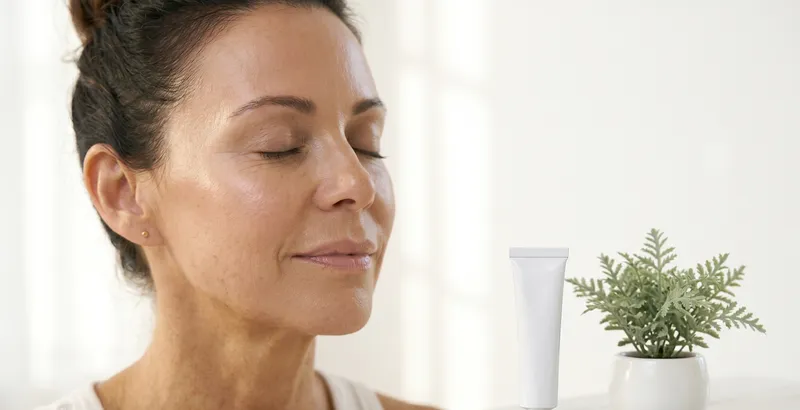
The science of skin aging is evolving rapidly — and for women navigating the skin changes that come with menopause and beyond, evidence-based skincare represents a fundamentally different approach: working with your skin's biology rather than against it.
Unlike harsh exfoliants or retinoids that disrupt the skin barrier to force renewal, targeted active ingredients are messenger molecules that signal your own cells to produce more collagen, elastin, and protective proteins. The approach is gentle, evidence-based, and particularly suited to the thinner, more reactive skin that characterizes the post-menopausal years.
Building a Gentle Yet Effective Regimen That Calms Redness and Repairs
Constructing a skincare routine for rosacea-prone mature skin demands a fundamental shift in philosophy from anti-aging to barrier-first care. The stratum corneum in rosacea patients is measurably compromised — transepidermal water loss (TEWL) studies show 30-40% higher moisture loss compared to healthy controls, and this barrier dysfunction worsens with age as ceramide production declines naturally. A 2020 study in the British Journal of Dermatology demonstrated that rosacea patients over 50 had significantly thinner epidermis and reduced ceramide-to-cholesterol ratios compared to age-matched controls without rosacea. This dual assault — rosacea-driven barrier damage plus age-related thinning — means that products tolerated by younger rosacea patients or by older patients without rosacea may be entirely too harsh for this population.[1]
The cleansing step represents the most critical juncture in a rosacea-mature skin routine. Surfactant-based cleansers strip the already-depleted lipid barrier, triggering reactive inflammation that can last 24-48 hours. Micellar waters, while gentle, leave surfactant residues that accumulate over time and increase sensitivity. The evidence supports lipid-based cleansing — either pure oils (jojoba, squalane) for makeup removal or synthetic detergent-free cleansing balms that emulsify with water without disrupting intercellular lipids. A comparative trial published in the Journal of Cosmetic Dermatology found that patients who switched from foaming cleansers to lipid-based alternatives showed a 45% reduction in baseline erythema after just four weeks, with corresponding improvements in barrier function as measured by TEWL.
Clinical research confirms that active ingredients for rosacea-prone mature skin must balance efficacy with tolerance. Retinoids — the gold standard for aging — are notoriously poorly tolerated by rosacea patients, with studies showing 60-70% flare rates even with low-concentration formulations. However, newer retinoid alternatives offer a path forward. Bakuchiol, a plant-derived retinol alternative, demonstrated comparable anti-wrinkle efficacy to 0.5% retinol without increasing erythema or scaling in a 2019 British Journal of Dermatology study. Peptides (particularly palmitoyl tripeptide-1 and copper peptides) stimulate collagen synthesis without triggering vasodilation. Centella asiatica derivatives (madecassoside, asiaticoside) simultaneously promote collagen remodeling and reduce inflammation — making them uniquely suited to the dual needs of rosacea-prone aging skin.
Layering order and product selection should follow the principle of progressive barrier reinforcement. After cleansing, a hydrating toner containing hyaluronic acid and panthenol prepares the skin to receive subsequent layers. A treatment serum with niacinamide (anti-inflammatory, barrier-strengthening) or azelaic acid (anti-redness, anti-microbial) addresses rosacea directly. A ceramide-rich moisturizer restores barrier lipids, and mineral sunscreen provides photoprotection without the chemical-filter irritation that plagues rosacea patients. Crucially, each product should be introduced individually over a 2-week period — never simultaneously — to identify any that provoke sensitivity. Research confirms that 'less is more' for rosacea: patients using 3-4 carefully selected products show better outcomes than those using 7-8 products, even when all individual products are technically rosacea-safe.
Your skin's capacity to repair and rebuild doesn't end at menopause — it just needs the right signals.
— Dr. Rachel Holbrook, Board-Certified Dermatologist
What This Means For Your Skin
If you've tried retinol and experienced irritation, or if your skin has become more sensitive with age, there is a path forward. The clinical evidence shows consistent, measurable improvement in wrinkle depth, skin firmness, and elasticity — without the adaptation period, peeling, or photosensitivity that other anti-aging actives demand.
Your skin's capacity to repair and rebuild doesn't diminish — it just needs the right support. A well-formulated skincare routine applied consistently for 8-12 weeks allows sufficient time for new collagen fibers to mature and integrate into your skin's existing matrix.
The science is clear. The evidence is consistent. The results are measurable.
What happens next is up to you.