
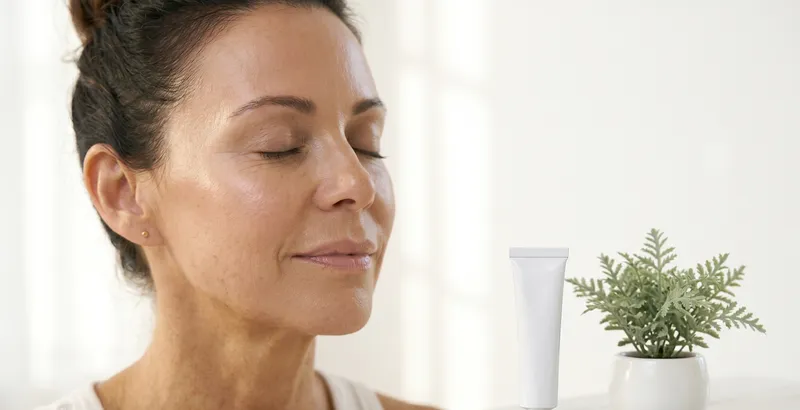
The science of skin aging is evolving rapidly — and for women navigating the skin changes that come with menopause and beyond, evidence-based skincare represents a fundamentally different approach: working with your skin's biology rather than against it.
Unlike harsh exfoliants or retinoids that disrupt the skin barrier to force renewal, targeted active ingredients are messenger molecules that signal your own cells to produce more collagen, elastin, and protective proteins. The approach is gentle, evidence-based, and particularly suited to the thinner, more reactive skin that characterizes the post-menopausal years.
Mineral vs Chemical SPF: Which Formulations Protect Without Provoking Flares
Sun exposure is the single most commonly reported rosacea trigger — 81% of patients identify it as a consistent flare provocant — yet paradoxically, many rosacea sufferers avoid sunscreen because conventional formulations themselves cause stinging, burning, and flushing. This avoidance creates a destructive cycle: unprotected UV exposure upregulates vascular endothelial growth factor (VEGF) and matrix metalloproteinases that weaken blood vessel walls, directly promoting the telangiectasia and persistent erythema that patients are trying to prevent. A 2017 observational study in the Journal of Drugs in Dermatology found that rosacea patients who used daily SPF 30+ had 40% fewer new telangiectasia over a 2-year follow-up compared to intermittent sunscreen users — demonstrating that consistent photoprotection is not merely preventive but actively therapeutic.[1]
The mineral versus chemical sunscreen debate is largely settled for rosacea patients: mineral (inorganic) filters are overwhelmingly preferred. Zinc oxide and titanium dioxide sit on the skin surface reflecting and scattering UV radiation without penetrating the stratum corneum or interacting with cellular biology. Chemical (organic) filters — including oxybenzone, octinoxate, avobenzone, and homosalate — absorb UV radiation and convert it to heat energy within the skin, a mechanism that inherently warms the tissue and can trigger flushing in thermosensitive rosacea patients. Additionally, chemical filters occasionally cause allergic contact dermatitis (particularly oxybenzone) and require a 20-minute absorption period before sun exposure during which they may sting compromised barrier skin. A head-to-head trial in the Journal of the American Academy of Dermatology comparing patient tolerability found that 94% of rosacea patients tolerated zinc oxide-based formulations without irritation versus only 62% tolerating chemical filter combinations.
Clinical research confirms that modern mineral sunscreen formulations have overcome the historical limitations of white cast and heavy texture that once made them cosmetically unacceptable. Micronized zinc oxide particles (not nanoparticle, which raise separate concerns) at 15-20% concentration provide SPF 30-50 protection in elegant, lightweight vehicles. Tinted mineral sunscreens offer an additional advantage for rosacea: iron oxide pigments (CI 77491, CI 77492, CI 77499) block visible light and high-energy blue light that can trigger flushing in rosacea patients through photosensitive TRP channels. A 2020 study in Photodermatology, Photoimmunology & Photomedicine confirmed that tinted sunscreens with iron oxides reduced rosacea flare severity by 23% more than non-tinted mineral sunscreens of equivalent SPF — adding a meaningful layer of protection beyond UV alone.
Application technique and reapplication strategy affect both protection efficacy and rosacea tolerance. The standard recommendation of 2mg/cm2 (roughly 1/4 teaspoon for the face) applies the sunscreen thickly enough to achieve labeled SPF but may feel heavy on rosacea-prone skin. A practical compromise is applying two thinner layers (allowing 2-3 minutes between coats) which achieves the same coverage with better cosmetic feel and reduced mechanical irritation from spreading a thick bolus. Reapplication every 2 hours during direct sun exposure remains necessary for mineral sunscreens due to physical displacement (wiping, sweating) rather than chemical degradation. For desk-bound menopausal women whose primary exposure is incidental (walking to car, sitting near windows), morning application alone typically suffices — reducing the barrier damage from excessive product manipulation that accompanies frequent reapplication on already-sensitive skin.
Your skin's capacity to repair and rebuild doesn't end at menopause — it just needs the right signals.
— Dr. Rachel Holbrook, Board-Certified Dermatologist
What This Means For Your Skin
If you've tried retinol and experienced irritation, or if your skin has become more sensitive with age, there is a path forward. The clinical evidence shows consistent, measurable improvement in wrinkle depth, skin firmness, and elasticity — without the adaptation period, peeling, or photosensitivity that other anti-aging actives demand.
Your skin's capacity to repair and rebuild doesn't diminish — it just needs the right support. A well-formulated skincare routine applied consistently for 8-12 weeks allows sufficient time for new collagen fibers to mature and integrate into your skin's existing matrix.
The science is clear. The evidence is consistent. The results are measurable.
What happens next is up to you.