
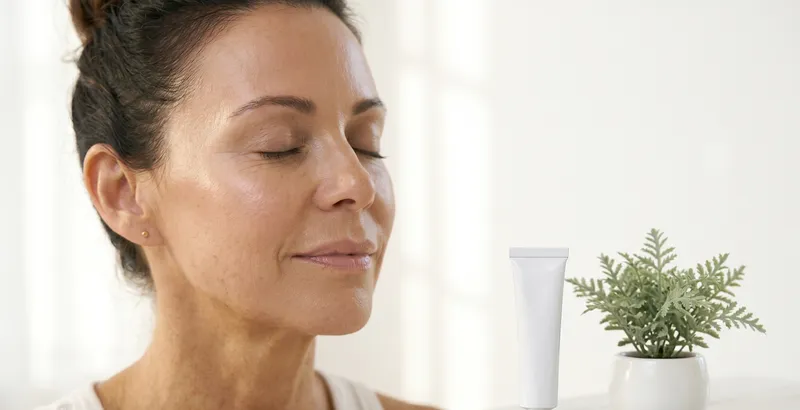
The science of skin aging is evolving rapidly — and for women navigating the skin changes that come with menopause and beyond, evidence-based skincare represents a fundamentally different approach: working with your skin's biology rather than against it.
Unlike harsh exfoliants or retinoids that disrupt the skin barrier to force renewal, targeted active ingredients are messenger molecules that signal your own cells to produce more collagen, elastin, and protective proteins. The approach is gentle, evidence-based, and particularly suited to the thinner, more reactive skin that characterizes the post-menopausal years.
Barrier-Repairing Formulas That Hydrate Without Triggering Redness or Stinging
Selecting a moisturizer for rosacea-prone menopausal skin requires understanding the specific lipid deficiencies present in this population. Normal human stratum corneum contains ceramides, cholesterol, and free fatty acids in a roughly 3:1:1 ratio that forms the waterproof barrier between the body and the environment. In rosacea patients, ceramide levels — particularly ceramide 1 (EOS) and ceramide 3 (NP) — are reduced by 25-40% according to lipidomic studies published in the Journal of Lipid Research. Menopause compounds this deficit: estrogen directly stimulates ceramide synthase enzymes, and its decline leads to progressive barrier deterioration independent of rosacea. The ideal moisturizer for this demographic must therefore provide both immediate humectant hydration and long-term barrier repair through physiological lipid replenishment.[1]
Ingredient safety for rosacea-prone skin follows well-established exclusion criteria. Fragrances (both natural and synthetic) are the most common sensitizers, with approximately 30% of rosacea patients reacting to fragrance components according to patch testing data. Alcohol denat (drying), witch hazel (astringent), menthol and camphor (counter-irritants), sodium lauryl sulfate (barrier-disrupting), and most essential oils trigger stinging or flushing in sensitive rosacea skin. Conversely, evidence supports several ingredients as actively beneficial: niacinamide at 2-5% strengthens barrier function and reduces transepidermal water loss by 20-30% over 4 weeks; panthenol (provitamin B5) accelerates barrier recovery after damage; allantoin reduces irritation; and squalane — a lipid identical to human sebum — provides occlusion without the comedogenicity or reactive flushing associated with heavier occlusives like petrolatum.
Clinical research confirms that formulation type matters as much as ingredient selection. Heavy creams in jars require preservative systems that may irritate sensitive skin and expose the product to bacterial contamination with each use. Lighter lotions often contain high concentrations of emulsifiers that can disrupt the lipid barrier over time. The evidence favors airless pump delivery systems with either oil-in-water emulsion bases (for oilier rosacea subtypes) or water-in-oil formulations (for severely dehydrated menopausal skin). A 2019 randomized controlled trial published in the Journal of Cosmetic Dermatology compared ceramide-containing moisturizers in different vehicle bases and found that those with cholesterol-dominant lipid ratios (mimicking the physiological 3:1:1 formula) produced significantly greater barrier recovery than ceramide-only formulations — supporting the principle that balanced lipid replacement outperforms single-ingredient approaches.
Application technique influences moisturizer efficacy and tolerance in rosacea-prone skin. The counter-intuitive finding from clinical observation is that applying moisturizer to slightly damp skin — within 60 seconds of cleansing — improves both hydration delivery and reduces the stinging sensation that many rosacea patients experience with topical application. This occurs because water on the skin surface dilutes potentially irritating ingredients and helps humectants draw moisture inward rather than pulling it from deeper skin layers. Gentle pressing (not rubbing) motion avoids the mechanical irritation that triggers flushing in sensitive facial vessels. For women using prescription rosacea treatments (metronidazole, azelaic acid, ivermectin), applying moisturizer first as a buffer reduces irritation without compromising active ingredient penetration — a technique validated in a 2016 split-face study showing equivalent therapeutic outcomes with significantly improved tolerability.
Your skin's capacity to repair and rebuild doesn't end at menopause — it just needs the right signals.
— Dr. Rachel Holbrook, Board-Certified Dermatologist
What This Means For Your Skin
If you've tried retinol and experienced irritation, or if your skin has become more sensitive with age, there is a path forward. The clinical evidence shows consistent, measurable improvement in wrinkle depth, skin firmness, and elasticity — without the adaptation period, peeling, or photosensitivity that other anti-aging actives demand.
Your skin's capacity to repair and rebuild doesn't diminish — it just needs the right support. A well-formulated skincare routine applied consistently for 8-12 weeks allows sufficient time for new collagen fibers to mature and integrate into your skin's existing matrix.
The science is clear. The evidence is consistent. The results are measurable.
What happens next is up to you.