
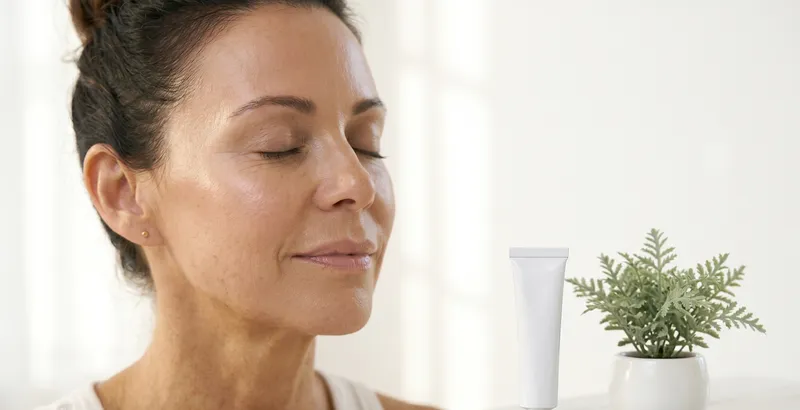
The science of skin aging is evolving rapidly — and for women navigating the skin changes that come with menopause and beyond, evidence-based skincare represents a fundamentally different approach: working with your skin's biology rather than against it.
Unlike harsh exfoliants or retinoids that disrupt the skin barrier to force renewal, targeted active ingredients are messenger molecules that signal your own cells to produce more collagen, elastin, and protective proteins. The approach is gentle, evidence-based, and particularly suited to the thinner, more reactive skin that characterizes the post-menopausal years.
The Vitamin B3 Derivative That Strengthens Barrier and Reduces Inflammation
Niacinamide (nicotinamide, vitamin B3) has emerged as one of the most versatile and well-tolerated active ingredients for rosacea-prone skin. Unlike many anti-redness treatments that work through a single mechanism, niacinamide addresses rosacea pathology at multiple levels simultaneously. It stimulates ceramide and fatty acid synthesis in keratinocytes, directly repairing the compromised barrier that characterizes rosacea skin. It inhibits the transfer of melanosomes to keratinocytes, reducing post-inflammatory hyperpigmentation from resolved rosacea lesions. It suppresses nuclear factor kappa B (NF-kB) signaling, reducing the production of inflammatory cytokines IL-1, IL-6, IL-8, and TNF-alpha that drive rosacea inflammation. And it reduces sebum production by 23% at 2% concentration according to a study in Clinical and Experimental Dermatology — relevant because excess sebum feeds Demodex mites implicated in rosacea.[1]
The clinical evidence supporting niacinamide for rosacea spans multiple study designs. A randomized double-blind trial published in the International Journal of Dermatology tested 4% niacinamide moisturizer versus vehicle in 50 rosacea patients over 12 weeks, finding significant improvements in erythema, dryness, and barrier function as measured by transepidermal water loss. A separate study in the British Journal of Dermatology demonstrated that 2% nicotinamide gel reduced pustule count by 60% over 8 weeks in papulopustular rosacea patients. For the erythematotelangiectatic subtype (primarily redness and flushing), niacinamide's barrier-strengthening effects reduce the sensitivity that amplifies flush intensity. Patient satisfaction scores consistently rank high because niacinamide does not cause initial worsening (purging) and integrates easily into existing routines without drug interactions or photosensitivity concerns.
Clinical research confirms that concentration selection and formulation compatibility require nuanced consideration for rosacea patients. While concentrations of 2-5% are well-established as safe and effective, higher concentrations (10%+) — popular in anti-aging formulations — may paradoxically trigger irritation and flushing in rosacea-prone skin. This appears related to niacin (nicotinic acid) contamination in lower-quality niacinamide sources: niacin activates GPR109A receptors on Langerhans cells, triggering prostaglandin D2 release and the characteristic niacin flush. Pharmaceutical-grade niacinamide contains less than 0.1% niacin contamination, while some cosmetic-grade sources contain up to 5% — explaining why patients sometimes react to one niacinamide product but not another despite identical listed concentrations. Serum formulations at 4-5% in a hydrating base (hyaluronic acid, glycerin) represent the optimal delivery for rosacea patients.
Niacinamide's compatibility profile makes it exceptionally easy to incorporate into comprehensive rosacea protocols. Unlike vitamin C (which requires low pH that can irritate), retinoids (which cause initial inflammation), or acids (which thin the barrier), niacinamide works at physiological pH and enhances the tolerability of other treatments when layered beneath them. It can be applied morning and evening, under azelaic acid or ivermectin prescriptions, alongside peptide treatments, and beneath mineral sunscreen. The only notable interaction caution involves concurrent use with high-concentration vitamin C at very low pH — while the old claim that they deactivate each other has been debunked, the low-pH environment needed for ascorbic acid stability may reduce niacinamide's efficacy temporarily. Separating them (vitamin C morning, niacinamide evening) eliminates any theoretical concern while allowing full benefit from both ingredients.
Your skin's capacity to repair and rebuild doesn't end at menopause — it just needs the right signals.
— Dr. Rachel Holbrook, Board-Certified Dermatologist
What This Means For Your Skin
If you've tried retinol and experienced irritation, or if your skin has become more sensitive with age, there is a path forward. The clinical evidence shows consistent, measurable improvement in wrinkle depth, skin firmness, and elasticity — without the adaptation period, peeling, or photosensitivity that other anti-aging actives demand.
Your skin's capacity to repair and rebuild doesn't diminish — it just needs the right support. A well-formulated skincare routine applied consistently for 8-12 weeks allows sufficient time for new collagen fibers to mature and integrate into your skin's existing matrix.
The science is clear. The evidence is consistent. The results are measurable.
What happens next is up to you.