
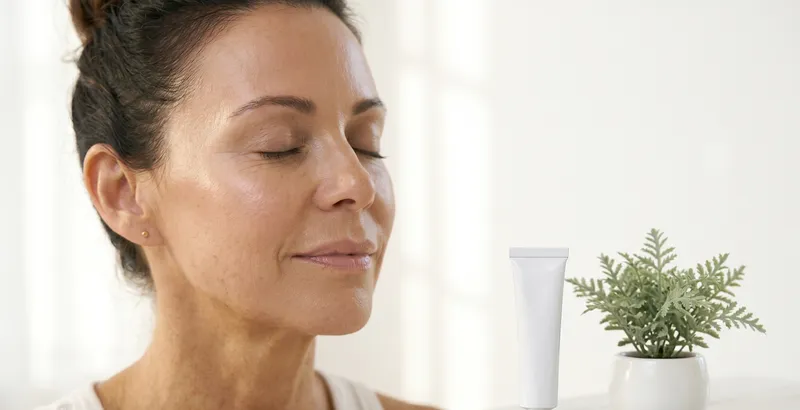
The science of skin aging is evolving rapidly — and for women navigating the skin changes that come with menopause and beyond, evidence-based skincare represents a fundamentally different approach: working with your skin's biology rather than against it.
Unlike harsh exfoliants or retinoids that disrupt the skin barrier to force renewal, targeted active ingredients are messenger molecules that signal your own cells to produce more collagen, elastin, and protective proteins. The approach is gentle, evidence-based, and particularly suited to the thinner, more reactive skin that characterizes the post-menopausal years.
Color-Correcting and Coverage Techniques That Conceal Without Irritating Skin
Cosmetic camouflage plays a vital psychological role in rosacea management — a 2019 quality-of-life study published in the British Journal of Dermatology found that rosacea patients who felt confident in their ability to conceal redness reported 42% better scores on the Dermatology Life Quality Index compared to those who avoided makeup due to fear of flares. However, the wrong products or techniques can genuinely worsen rosacea, creating a legitimate dilemma. Ingredients to avoid in foundations and concealers include fragrance (the number one cosmetic sensitizer), talc (which can harbor microbes and dry the skin), bismuth oxychloride (causes itching and burning in many sensitive skin types), and high-alcohol quick-dry formulations that strip the barrier. The ideal rosacea-safe makeup contains mineral pigments (iron oxides, titanium dioxide, zinc oxide) in a moisturizing base that doubles as barrier protection rather than merely sitting atop the skin.[1]
Color theory provides the foundation for effective redness concealment. On the color wheel, green sits directly opposite red, making green-tinted primers and color correctors the most efficient neutralizers of erythema. However, application technique matters: green pigments should be applied only to actively red areas (central cheeks, nose, chin) in a thin, stippled layer — applying broadly creates an ashen, unnatural cast. For moderate redness, a yellow-toned primer applied over the entire face provides subtler correction while evening overall skin tone. The layering sequence for maximum coverage with minimum product load is: moisturizer (barrier protection) -> mineral sunscreen (photoprotection + primer properties of zinc oxide) -> targeted green color corrector on red zones -> medium-coverage mineral foundation -> concealer only on persistent spots. Each layer should be set with a clean brush using gentle pressing — never rubbing — motions.
Clinical research confirms that application tools significantly impact both coverage quality and skin irritation. Rosacea-prone skin is mechanically sensitive — the friction from repeated brush strokes or aggressive beauty blender bouncing can trigger flushing and worsen baseline erythema. Silicone application sponges (non-porous, non-absorbent) deposit product without absorbing it, reducing waste and bacterial contamination. For brush application, synthetic taklon bristles in kabuki or stippling brush forms provide gentle deposit with minimal drag. Importantly, all tools must be cleaned weekly at minimum — makeup brushes harbor bacteria and Demodex mites that recontaminate the skin with each use. A 2018 study in the Journal of Applied Microbiology found that 79% of regularly used makeup sponges tested positive for Enterobacteriaceae and 26% for Staphylococcus aureus — both capable of triggering inflammatory responses in rosacea-compromised skin.
Removal of makeup in the evening is as important as application technique. Rosacea patients who sleep in makeup experience significantly worse barrier function and increased Demodex colonization compared to those who cleanse thoroughly each night. However, aggressive makeup removal (rubbing with cotton pads, using alcohol-based removers, or double-cleansing with surfactant cleansers) causes mechanical and chemical irritation that offsets any benefit from gentle application. Oil-based cleansing balms that dissolve makeup on contact and rinse clean without rubbing represent the optimal removal method for rosacea-prone skin. Micellar water is often recommended but should be rinsed rather than left on the skin, as residual surfactants contribute to cumulative barrier disruption over time. The post-removal routine should immediately restore barrier function with a ceramide moisturizer, taking advantage of the temporarily enhanced penetration that cleansing provides.
Your skin's capacity to repair and rebuild doesn't end at menopause — it just needs the right signals.
— Dr. Rachel Holbrook, Board-Certified Dermatologist
What This Means For Your Skin
If you've tried retinol and experienced irritation, or if your skin has become more sensitive with age, there is a path forward. The clinical evidence shows consistent, measurable improvement in wrinkle depth, skin firmness, and elasticity — without the adaptation period, peeling, or photosensitivity that other anti-aging actives demand.
Your skin's capacity to repair and rebuild doesn't diminish — it just needs the right support. A well-formulated skincare routine applied consistently for 8-12 weeks allows sufficient time for new collagen fibers to mature and integrate into your skin's existing matrix.
The science is clear. The evidence is consistent. The results are measurable.
What happens next is up to you.